RES Exam Syllabus 2027: What's Changed and What It Means for You
CEA's first full rewrite of the syllabus since 2017. The format stays the same, but there are new topics to learn and old rules to unlearn.
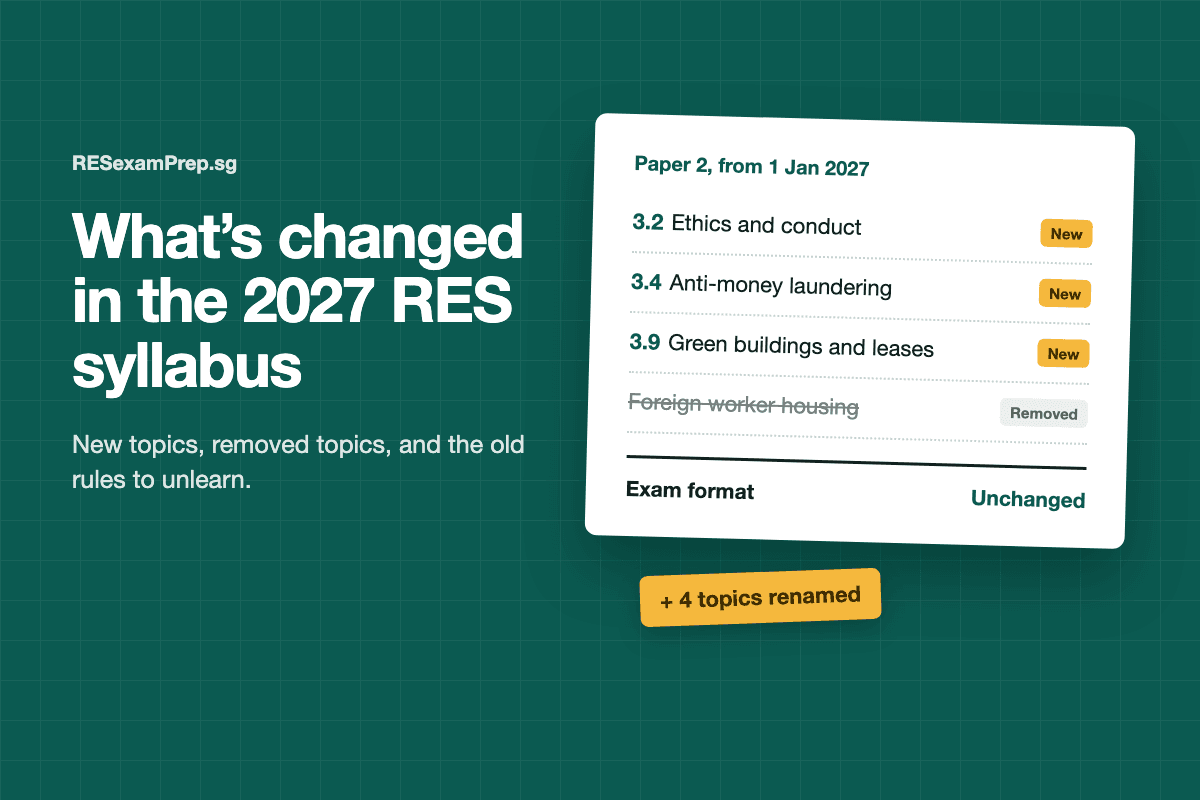
From 1 January 2027, every Real Estate Salesperson (RES) exam is based on a new syllabus from the Council for Estate Agencies (CEA). This guide compares it with the old one line by line, using CEA's 2027 syllabus and its FAQ on the revision.
- Starts
- 1 Jan 2027
- Every exam, retakes included.
- Exam format
- Unchanged
- 2 papers of 2.5 hours, 80 MCQs each.
- Topics
- 3 new, 1 removed
- Plus 4 renamed. All 3 new topics are in Paper 2.
- RES course
- 65 hours
- Up from at least 50 hours.
CEA's own summary lists the new, removed and renamed topics. It leaves out most of the change. Comparing the two documents, the new syllabus has about 40 more learning outcomes, and almost every topic gained something. Several rules you may have studied are now out of date.
Does the new syllabus apply to you?
It depends on when you sit the exam, not when you took the course.
- You sit the exam in 2026
- You're tested on the old syllabus. Nothing changes for you.
- You sit any exam from 1 Jan 2027
- You're tested on the 2027 syllabus. This includes retakes, even if you studied the old one.
- You finished the course on the old syllabus
- You don't need to redo the course, as long as you sit the exam within 2 years of finishing it. Bridging courses are optional and you can self-study the new topics. A bridging course does not extend your course certificate.
- You've passed one paper already
- Your pass still counts if it's within 2 years of finishing the course. You only retake the paper you failed, and that paper follows the 2027 syllabus.
- You haven't signed up for a course yet
- Pick an intake that teaches the 2027 syllabus. Most providers now run them, and several raised their fees for the longer course. Compare them in our RES course providers guide.
Source: CEA's FAQ on the revised RES syllabus (PDF, 27 Aug 2025). The certificate rules are explained in our guide to registering for the RES exam.
The 3 new topics, all in Paper 2
Each new topic slots into Unit 3, so most of the Paper 2 numbers after 3.1 shift. Two of the three are tested at Level 3, the highest of CEA's three levels, which means you must apply them to a situation, not just recall them.
3.2 Professional practice, ethics and conduct
CEA recommends 2.5 hours of training. Both learning outcomes are Level 3. Ethics was mentioned in the old syllabus, mainly through CEA's Code of Ethics and Professional Client Care (CEPCC). It is now a topic of its own, built around five principles:
- Professionalism: act with honesty, propriety and fairness, and send clients to solicitors, tax advisers or valuers when a question is outside your expertise.
- Integrity: base your advice on reliable evidence you can back up.
- Ethical dilemmas: in advertising, in co-broking, and when your commission pulls against the client's interest.
- Duty to clients and the public: disclosure, privacy and confidentiality, and keeping conflicts of interest to a minimum.
- Conduct towards other agents: including CEA's Practice Guidelines on Conduct of Estate Agents and Real Estate Salespersons Towards One Another.
3.4 Prevention of money laundering, proliferation financing and terrorism financing (PMLPFTF)
CEA recommends 2.5 hours. In the old syllabus, the Estate Agents (PMLPFTF) Regulations 2021 were one line in a list of laws to keep up with. Now they have five learning outcomes, four at Level 3. You need to know:
- Your duties under the Estate Agents (PMLPFTF) Regulations 2021, the Corruption, Drug Trafficking and Other Serious Crimes (Confiscation of Benefits) Act (CDSA), the Terrorism (Suppression of Financing) Act (TSOFA) and the United Nations Act.
- Customer due diligence (CDD): how to use CEA's checklists, how to explain CDD to clients, and when enhanced CDD and screening are needed.
- Risk assessment, finding the beneficial owner, and spotting suspicious indicators.
- When to file a suspicious transaction report (STR), when to report terrorism-financing information to the police, and what happens if you don't.
3.9 Green buildings and leases
The smallest of the three, with 1 recommended hour and every learning outcome at Level 2 (understand and explain). It covers:
- The objectives of BCA's Green Mark certification scheme.
- Its key criteria and benefits, explained the way you would to a buyer or tenant.
- Green lease clauses on energy efficiency, water efficiency, sustainable materials, waste management, indoor environmental quality, and occupant comfort and well-being.
What was removed, and the 4 renamed topics
Foreign worker housing (old 4.7) is gone. The part on checking a tenant's immigration status survives: it moved into the leasing topics, 4.5 and 4.6. Paper 1 also loses Conveyance inter vivos (old 2.5), but that topic only pointed to Paper 2, where conveyancing is still taught. Two smaller items were cut: converting a postal code to its old district number, and methods to qualify prospective customers.
The renamed topics aren't only new titles. Each one gained content:
- 1.6 State Lands Act and Land Betterment Charge Act (was State Lands Act): Land Betterment Charges replace differential premium. Road reserves and encroachment are new.
- 2.4 Property torts (was Negligence): adds the tort of trespass to land, with its four elements, defences and remedies, and the types of nuisance, including what “nuisance” means in a tenancy agreement.
- 3.13 Marketing of conservation properties (was Marketing of special properties): goes from 3 to 7 learning outcomes. It names the four types of conservation area and the rules for each, the 3Rs (maximum retention, sensitive restoration, careful repair), and the approvals needed for awnings, gazebos and swimming pools.
- 4.5 Leasing of private residential properties (was Leasing of private properties): adds Immigration Act and Women's Charter checks on tenants, approved use, and the property condition report.
Every topic, old and new numbers side by side
If your notes use the old numbering, use this table to find where each topic went. Hours are CEA's recommended training hours, which it now gives for every topic.
- New topic
- Did not exist in the old syllabus.
- Renamed
- New title, with new content inside.
- Added content
- Same title, at least one new learning outcome.
- Rules updated
- No new learning outcomes, but the rules tested are now current.
- Removed
- No longer tested.
| No. | Topic and what changed | Hours |
|---|---|---|
| 1.1 | Real estate market and submarketsAdded content How State land is sold (GLS, IGLS) and valued. Postal-district conversion dropped. | 1.5 h |
| 1.2 | Real estate market players and government interventionAdded content How BTO flats are priced, including Standard, Plus and Prime flats. | 1 h |
| 1.3 | Introduction One learning outcome split into four. | 1.5 h |
| 1.4 | LandAdded content How fixtures and fittings affect annual value, property tax and market value. | 2 h |
| 1.5 | Estates in land | 1 h |
| 1.6 | State Lands Act and Land Betterment Charge ActRenamed Was “State Lands Act”. Land Betterment Charges replace differential premium. Road reserves and encroachment are new. | 1 h |
| 1.7 | Rights in another’s land | 1.5 h |
| 1.8 | Registration of titles Adds the subsidiary certificate of title. | 1.5 h |
| 2.1 | Law of contractAdded content Express and implied terms, exemption and indemnity clauses, mistake, illegality, undue influence and duress. | 5 h |
| 2.2 | Law of agencyAdded content Uberrimae fidei dropped. New: the salesperson’s role while engaged by an estate agent. | 3 h |
| 2.3 | Landlord and tenant lawAdded content Distress for rent under the Distress Act. | 3 h |
| 2.4 | Property tortsRenamed Was “Negligence”. Trespass and nuisance join negligence. | 3 h |
| Removed, was | Conveyance inter vivosRemoved It only pointed to Paper 2, which still covers conveyancing. | – |
| 2.5was 2.6 | Mortgage Names foreclosure and CPF Board charges. | 1.5 h |
| 2.6was 2.7 | Gift | 1 h |
| 2.7was 2.8 | TrustAdded content Roles of trustee and beneficiary. | 1 h |
| 2.8was 2.9 | Succession | 1 h |
| 2.9was 2.10 | Future interests | 1 h |
| 2.10was 2.11 | Co-ownership | 1 h |
| 2.11was 2.12 | Restrictions on capacity to hold land | 1 h |
| 2.12was 2.13 | Planning and development of landAdded content Co-living and co-working spaces. URA Space. | 2.5 h |
| Recommended training hours, Paper 1 | 35 h |
| No. | Topic and what changed | Hours |
|---|---|---|
| 3.1 | Regulation of real estate agency industry Purpose of professional indemnity insurance. You don’t need to memorise the minimum amounts. | 2 h |
| 3.2 | Professional practice, ethics and conductNew topic | 2.5 h |
| 3.3was 3.2 | Role and functions of salespersons and their requisite knowledge and skills | 2.5 h |
| 3.4 | Prevention of Money Laundering, Proliferation Financing and Terrorism Financing (PMLPFTF) obligationsNew topic | 2.5 h |
| 3.5was 3.3 | Principles of real estate marketing Spells out the 4Ps. “Qualifying prospective customers” dropped. | 1 h |
| 3.6was 3.4 | Types of listing | 1 h |
| 3.7was 3.5 | Methods of sale | 1 h |
| 3.8was 3.6 | Regulations on advertisements Adds social media, videos, virtual viewings and the guidelines on marketing foreign properties. | 1 h |
| 3.9 | Green buildings and leasesNew topic | 1 h |
| 3.10was 3.7 | Marketing of residential propertiesAdded content CONQUAS and Quality Mark. Penalties for illegal use. Good class bungalows. | 2.5 h |
| 3.11was 3.8 | Marketing of commercial propertiesAdded content Grows from 7 to 13 learning outcomes: commercial lease terms, change of use, and the FTIC retail leasing Code of Conduct. | 2 h |
| 3.12was 3.9 | Marketing of industrial propertiesAdded content B1 and B2 zoning, industrial lease terms, approved use and penalties. | 2 h |
| 3.13was 3.10 | Marketing of conservation propertiesRenamed Was “Marketing of special properties”. Grows from 3 to 7 learning outcomes: conservation areas by type, the 3Rs, and alteration rules. | 2 h |
| 3.14was 3.11 | Consumer Protection (Fair Trading) Act 2003 | 1 h |
| 4.1 | Sale of uncompleted private properties | 2 h |
| 4.2 | Sale of completed private properties Names INLIS, REALIS and HDB InfoWEB for title checks. | 2 h |
| 4.3 | Collective sale of private propertiesAdded content Selling your own unit after signing, “break lease” clauses, and prices from failed sales. | 1 h |
| 4.4 | Sale of HDB flatsAdded content Prime, Plus and Standard flats, including resale restrictions. | 3 h |
| 4.5 | Leasing of private residential propertiesRenamed Was “Leasing of private properties”. Immigration Act and Women’s Charter checks. Property condition report. | 1.5 h |
| 4.6 | Renting out HDB flats/bedrooms The application procedure is now its own learning outcome. | 2 h |
| Removed, was | Foreign worker housingRemoved Tenant immigration checks moved into 4.5 and 4.6. | – |
| 4.7was 4.8 | Taxes on property | 1.5 h |
| 4.8was 4.9 | Property finance and financial calculationsRules updated HFE letter replaces HLE. CPF use now follows the age-95 lease rule and retirement sums. | 2 h |
| Recommended training hours, Paper 2 | 39 h |
Old rules to unlearn
The old syllabus was written in 2017 and still described some rules that have since changed. The 2027 version brings them up to date. If you study from older notes or question banks, watch for these:
| Old syllabus | 2027 syllabus |
|---|---|
| Differential premium | Land Betterment Charges (LBC), under the Land Betterment Charge Act 2021 |
| HDB Loan Eligibility (HLE) letter | HDB Flat Eligibility (HFE) letter |
| CPF Valuation Limit, Minimum Sum, and % withdrawal limits for 30 to 60-year leases | Full and Basic Retirement Sums, CPF Housing Limits, and whether the lease covers the youngest buyer to age 95 |
| Agency as a contract uberrimae fidei (of utmost good faith) | Agency as a fiduciary relationship, versus the mainly contractual estate agent–client relationship |
| New flats, with DBSS flats in the allocation and eligibility rules | Standard, Plus and Prime BTO flats. DBSS is dropped from new-flat allocation and eligibility |
| Negligent misrepresentation | Negligent misstatement |
Bigger changes inside existing topics
These topics kept their names, so CEA's summary doesn't mention them. Each gained new learning outcomes.
Law of contract (2.1)
Already the largest Paper 1 topic, and it grew from 6 to 8 learning outcomes. New: express and implied terms, exemption clauses and when they are valid, indemnity clauses, and the intention to create legal relations. Misrepresentation is now one of several vitiating factors, alongside mistake, illegality, undue influence and duress.
Law of agency (2.2)
Every learning outcome moved down from Level 3 (apply) to Level 2 (understand), so expect questions that ask you to explain or classify, rather than apply. There is one new item: your role as an agent while working under an estate agent, including the difference between a contract of service and a contract for service.
Public housing (1.2 and 4.4)
The syllabus now covers how BTO flats are priced, and the Standard, Plus and Prime flat classifications: what each one is, how they differ, and their resale restrictions.
Commercial and industrial properties (3.11 and 3.12)
Commercial grows from 7 to 13 learning outcomes, and industrial from 7 to 10. Both add lease terms, approved use, and penalties for unauthorised use. Commercial adds the Fair Tenancy Industry Committee (FTIC) Code of Conduct for Leasing of Retail Premises, including how disputes go to the FTIC before a lease is signed and to the Singapore Mediation Centre after.
Smaller additions worth knowing
- How State land is sold through the Government Land Sales (GLS) and Industrial GLS programmes (1.1).
- How fixtures and fittings affect annual value, property tax and market value (1.4).
- Distress for rent under the Distress Act (2.3).
- Co-living and co-working spaces, and URA's rules on them (2.12).
- CONQUAS scores and the Quality Mark in marketing (3.10).
- Collective sales: selling your unit after signing, “break lease” clauses, and pricing units from a failed collective sale (4.3).
How to study for the 2027 syllabus
- Study from the 2027 PDF, not old notes
- Notes, textbooks and question banks written before 2027 still teach retired rules such as the HLE letter and differential premium. Download the official 2027 syllabus (PDF) and check every topic against it.
- Use the Explanatory Notes column as a checklist
- The 2027 syllabus has a new column that often lists exactly what is tested: the four elements of trespass, the six green lease clauses, the four types of conservation area. If a list appears there, learn every item on it.
- Practise the new topics as scenarios
- Ethics and anti-money laundering are tested at Level 3, so expect questions that describe a client and ask what you should do. These suit the Section B case studies, worth 2 marks each.
- Spend your time where CEA spends its hours
- Law of contract (5 hours) is the biggest topic in Paper 1. In Paper 2, the largest are Sale of HDB flats (3 hours), then ethics, anti-money laundering, the salesperson's role, and marketing residential property (2.5 hours each).
- Track your progress topic by topic
- Our free 2027 syllabus tracker lists every learning outcome in both papers. Tick them off as you go.
For the topics candidates already found hardest, see the 5 most difficult RES exam topics. For an overview of each paper, see Paper 1 and Paper 2.
Also new in 2027, but not in the syllabus
From 1 January 2027, CEA registration for salespersons lasts 3 years instead of 1, and renewal comes with a new Currency Requirement. This affects you after you pass, not the exam itself. The details are in our post on what it costs to become a property agent.
Frequently Asked Questions
When does the new RES exam syllabus start?
The 2027 syllabus applies to every RES exam from 1 January 2027, including retakes. Exams held in 2025 and 2026 use the old syllabus.
What are the new topics in the 2027 RES syllabus?
Three new topics, all in Paper 2: 3.2 Professional practice, ethics and conduct; 3.4 Prevention of Money Laundering, Proliferation Financing and Terrorism Financing (PMLPFTF) obligations; and 3.9 Green buildings and leases. Foreign worker housing has been removed.
Has the RES exam format changed for 2027?
No. There are still two papers of 2.5 hours each. Each has 60 multiple-choice questions worth 1 mark (Section A) and 20 case-study questions worth 2 marks (Section B).
I finished the RES course on the old syllabus. Do I have to retake it?
No, as long as you sit the exam within 2 years of finishing the course. Bridging courses are optional and you can self-study the new topics instead. A bridging course does not extend your course certificate.
I passed one paper in 2026. Do I have to retake it in 2027?
No. A pass in Paper 1 or Paper 2 within 2 years of finishing the course still counts. You only retake the paper you failed, and that paper is based on the 2027 syllabus.
Is the RES course longer under the 2027 syllabus?
Yes. The RES course must now be at least 65 hours, up from at least 50 hours. CEA also gives recommended training hours for every topic: 35 hours for Paper 1 and 39 hours for Paper 2.
Where can I download the official 2027 RES syllabus?
From CEA's 'Prepare for the real estate salesperson examination' page, which links to the 2027 syllabus PDF and CEA's FAQ on the revision.
All of CEA's documents are on its exam preparation page. We compared the 2027 syllabus (v1.0) with the 2017 syllabus (v1.4, January 2026) on 9 Nov 2026.
Practise on the 2027 syllabus
Our questions are tagged to the 2027 learning outcomes and written in the real exam format, with case studies for Section B.