How to Register for the RES Exam in Singapore (2027)
Who can sit, how the two-stage registration works, what it costs, what to bring on exam day, and what happens after your results.
The Real Estate Salesperson (RES) exam is the last step before you can register as a property agent in Singapore. Getting a seat is its own challenge: each sitting has about 3,000 seats, given out first-come, first-served, and CEA warns that not everyone who applies will get one.
What's changed for 2027
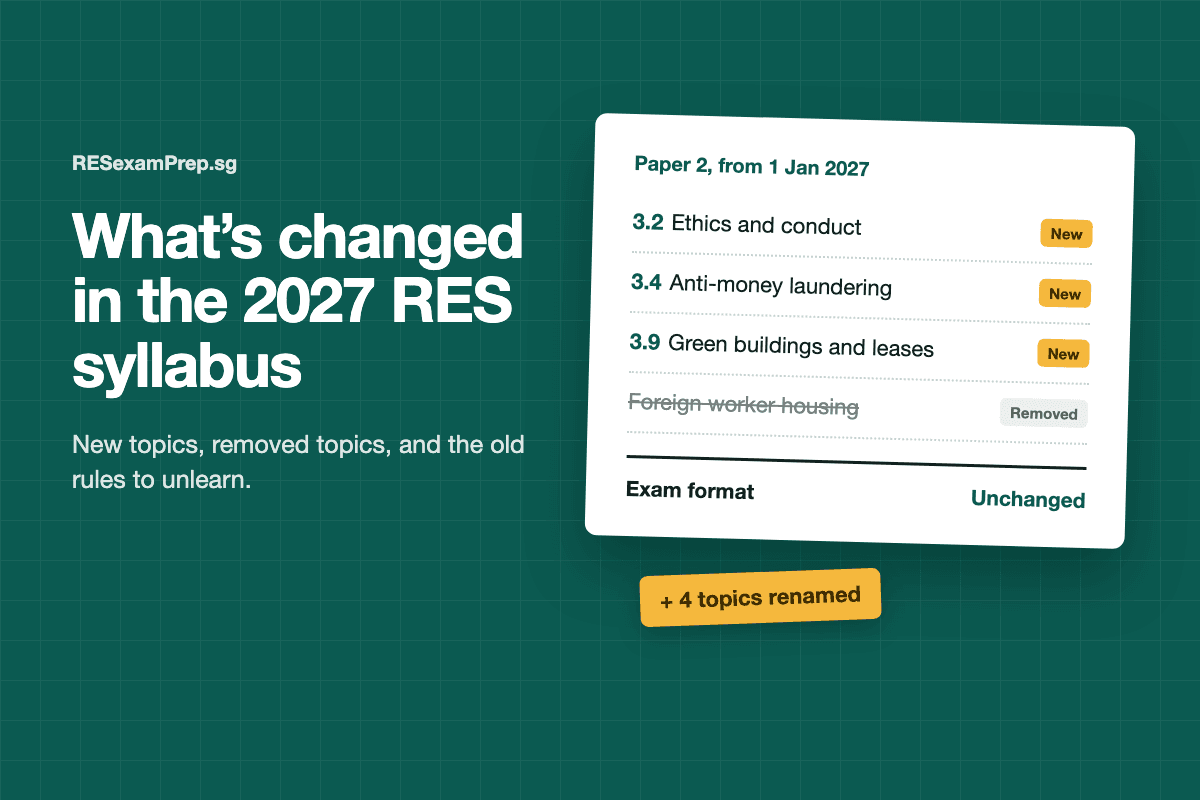
- A new syllabus applies from 1 January 2027. The format stays the same, but topics change. See the 2027 RES exam syllabus.
- The 2027 exam dates are out. The papers are on 13–14 March, 17–18 July and 30–31 October. See the 2027 schedule.
- Stage 2 now runs Friday to Monday, not Thursday to Sunday as in 2026.
Who Can Register for the RES Exam
You need all three of these when you register:
A Certificate of RES Course Completion
Complete the RES course with a CEA-approved course provider and attend at least 75% of it. Only certificates from approved providers count.
A certificate that is still valid
The certificate is valid for two years from your course completion date, and you must sit the exam within that window. CEA does not extend it. After it expires, you redo the course.
At least 4 GCE O-Level passes, or an equivalent
Results can come from up to two sittings. Equivalents include 4 A-Level passes, a Higher NITEC, a local polytechnic diploma or university degree, or Level 5 and above in all five WPLN components. For an overseas or private qualification, send it to CEA (licensing@cea.gov.sg) with the Educational Qualification Assessment form before you register. CEA takes about 15 working days, and its assessment letter is valid for three years.
Finish your course before the cut-off
Each sitting has a course-completion deadline, always the day before Stage 1. For the March 2027 exam, you must finish by Tuesday 19 January 2027, and Stage 1 is on Wednesday 20 January.
Exemptions: NUS BBA (Real Estate) graduates, and NUS BSc (Real Estate) and NP Diploma in Real Estate Business graduates who enrolled on or after 1 April 2020, are exempt from Paper 1. They take a partial course and sit Paper 2 only. Those who enrolled earlier, and holders of some discontinued real estate degrees and diplomas, are fully exempt. CEA's exam page has the full list. For the full picture of what it takes to become an agent, see our entry criteria guide.
Exam Format and Pass Mark
The RES exam has two papers, each 2.5 hours long, and you must pass both. It is a paper-based exam, and the format doesn't change in 2027.
Paper 1 (100 marks)
- Competency Unit 1: Real estate agency industry overview and basic land law concepts
- Competency Unit 2: Dealings with interests in land
Paper 2 (100 marks)
- Competency Unit 3: Regulation of the real estate agency industry and real estate marketing
- Competency Unit 4: Property transactions
Both papers:
- Section A: 60 multiple-choice questions (60 marks)
- Section B: 20 multiple-choice questions on one or two case studies (40 marks)
- Pass mark: 60 per paper. Results show Pass or Fail only, not your score.
For what each paper covers, topic by topic, see the Paper 1 and Paper 2 overviews.
You won't be tested on policy changes announced or brought in within one month before the exam. From 2027 the topics follow the revised syllabus, which adds units on professional ethics, anti-money laundering and green buildings.
RES Exam Schedule 2027
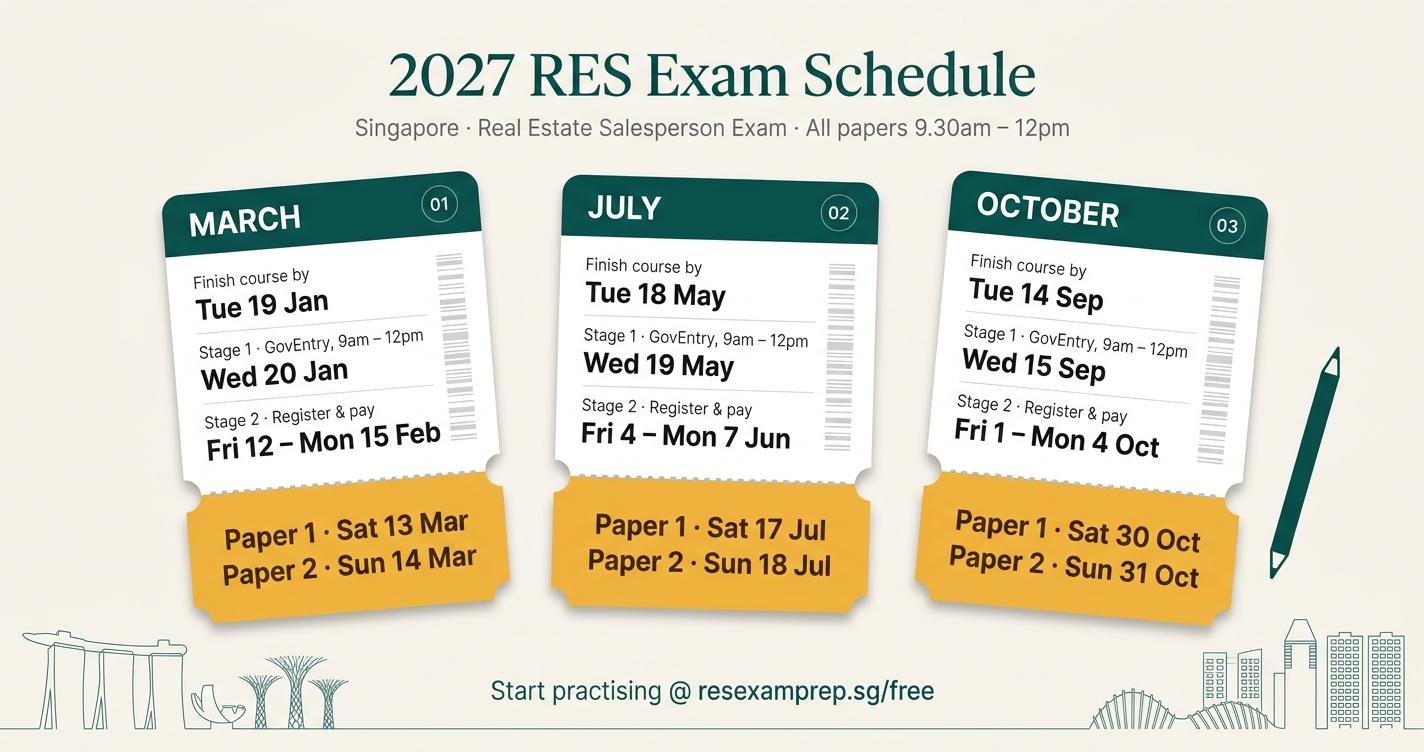
The RES exam runs three times a year. In 2027 the sittings are in March, July and October. Paper 1 is on Saturday and Paper 2 on Sunday, both from 9.30am to 12pm. All three sittings test the 2027 syllabus.
Prefer a quick visual? See the 2027 RES exam schedule at a glance for all three sittings on one page.
Mar 2027 exam
- Finish course by
- 19 Jan 2027, Tue
- Stage 1, 9am–12pm
- 20 Jan 2027, Wed
- Stage 2
- 12–15 Feb 2027, Fri–Mon
- Paper 1
- 13 Mar, Sat
- Paper 2
- 14 Mar, Sun
Jul 2027 exam
- Finish course by
- 18 May 2027, Tue
- Stage 1, 9am–12pm
- 19 May 2027, Wed
- Stage 2
- 4–7 Jun 2027, Fri–Mon
- Paper 1
- 17 Jul, Sat
- Paper 2
- 18 Jul, Sun
Oct 2027 exam
- Finish course by
- 14 Sep 2027, Tue
- Stage 1, 9am–12pm
- 15 Sep 2027, Wed
- Stage 2
- 1–4 Oct 2027, Fri–Mon
- Paper 1
- 30 Oct, Sat
- Paper 2
- 31 Oct, Sun
| Sitting | Exam dates | Finish course by | Stage 1 Indicate interest, 9am–12pm | Stage 2 Register and pay (NTUC LearningHub) |
|---|---|---|---|---|
| Mar 2027 | P1: 13 Mar, Sat P2: 14 Mar, Sun | 19 Jan 2027, Tue | 20 Jan 2027, Wed | 12–15 Feb 2027, Fri–Mon |
| Jul 2027 | P1: 17 Jul, Sat P2: 18 Jul, Sun | 18 May 2027, Tue | 19 May 2027, Wed | 4–7 Jun 2027, Fri–Mon |
| Oct 2027 | P1: 30 Oct, Sat P2: 31 Oct, Sun | 14 Sep 2027, Tue | 15 Sep 2027, Wed | 1–4 Oct 2027, Fri–Mon |
Source: CEA's 2027 examination schedule, checked 13 Nov 2026. CEA says dates and registration periods may change.
What's different from 2026
- Stage 2 runs Friday to Monday. In 2026 it ran Thursday to Sunday.
- Stage 1 is always on a Wednesday, and the course cut-off is the Tuesday before.
- The third sitting is fully in October (30–31 Oct), not split across October and November.
- CEA hasn't named the 2027 venue. The 2026 exams were at SIM HQ, 461 Clementi Road. LHUB emails your exam details about five days before the exam.
How to Register: GovEntry and NTUC LearningHub
Registration happens in two steps. In Stage 1 you tell CEA you want a seat. If you are shortlisted, you register and pay in Stage 2. NTUC LearningHub (LHUB) is CEA's exam administrator and handles everything from Stage 2 onwards.
Stage 1: Indicate Your Interest on GovEntry
Stage 1 is open for three hours, from 9am to 12 noon on a single weekday. Seats go to eligible applicants in the order they submit, so being ready at 9am matters.
Get ready before the day
- Finish your course by the cut-off and have your certificate.
- Check that your Singpass works. If you'll be overseas, turn on overseas access in your Singpass settings first.
- Use a personal phone or computer with an up-to-date browser and cookies allowed. Work laptops with security software can fail after the Singpass login.
- Download CEA's infographic for that sitting. It has the GovEntry link and QR code, so you don't have to rely on busy websites at 9am.
Open the GovEntry link at 9am
Check that the link ends in gov.sg. Open it in a normal browser such as Chrome or Safari. Singpass doesn't work in in-app browsers, such as links opened inside WeChat.
Log in with Singpass and fill in the form
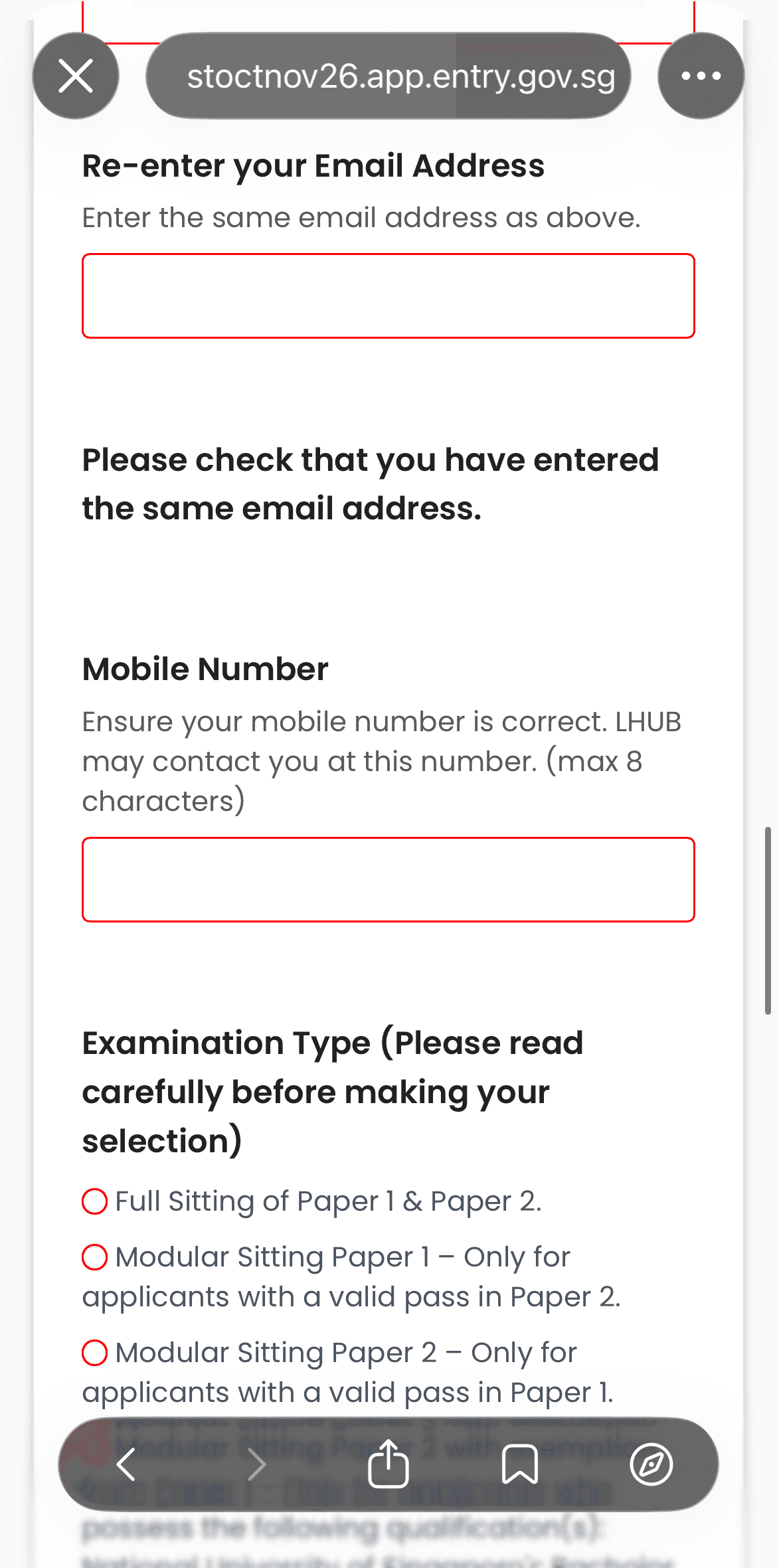
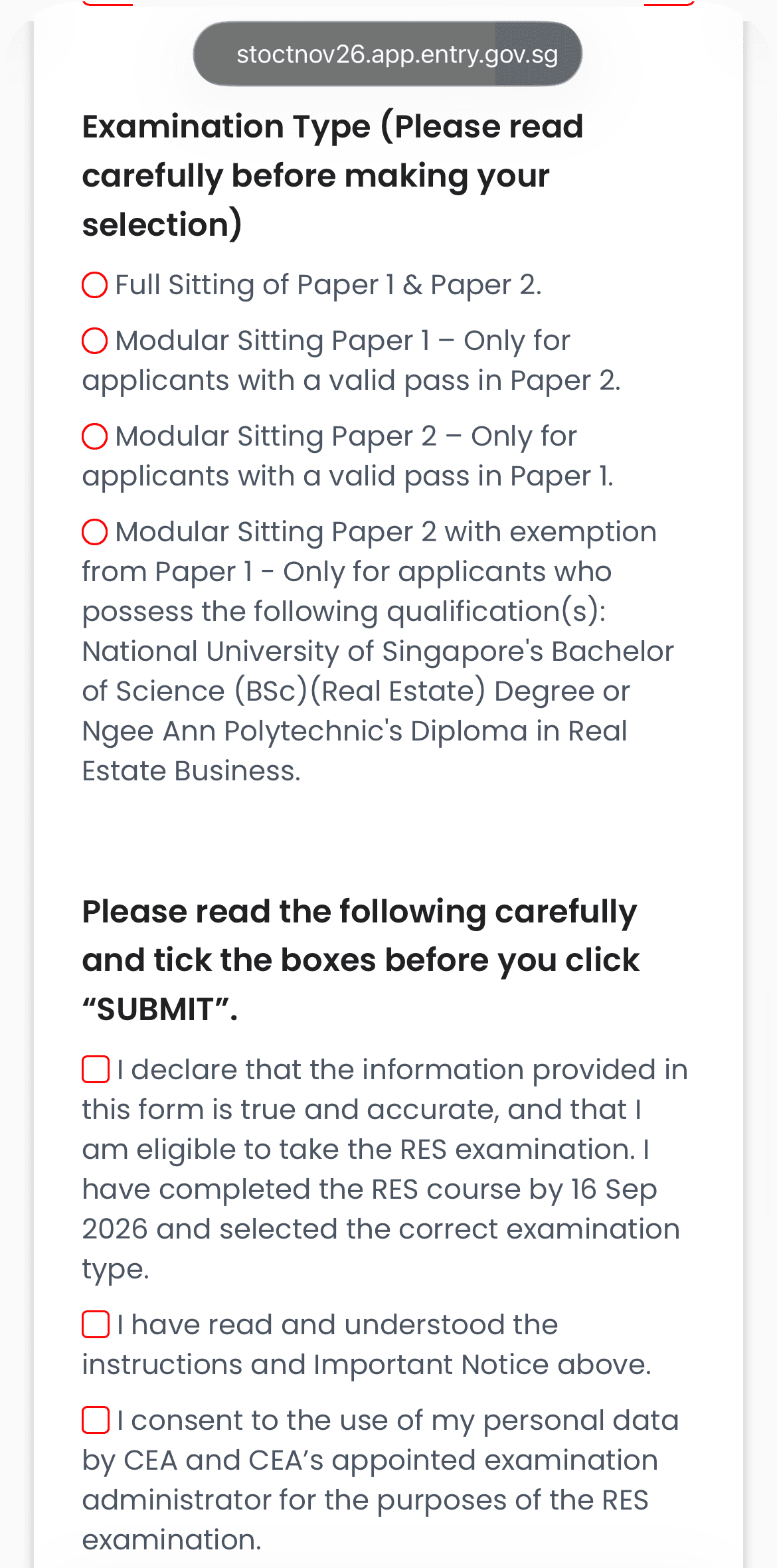
It takes about five minutes. You enter your full name as on your NRIC/FIN, your email (twice, to confirm it) and your mobile number, then choose one of four exam types:
- Full sitting (Paper 1 and Paper 2), if it's your first attempt or you failed both papers
- Modular Paper 1, if you passed Paper 2
- Modular Paper 2, if you passed Paper 1
- Modular Paper 2 with exemption from Paper 1, for exempt graduates
Choose carefully. Picking the wrong exam type disqualifies you, and CEA can't change it for you.
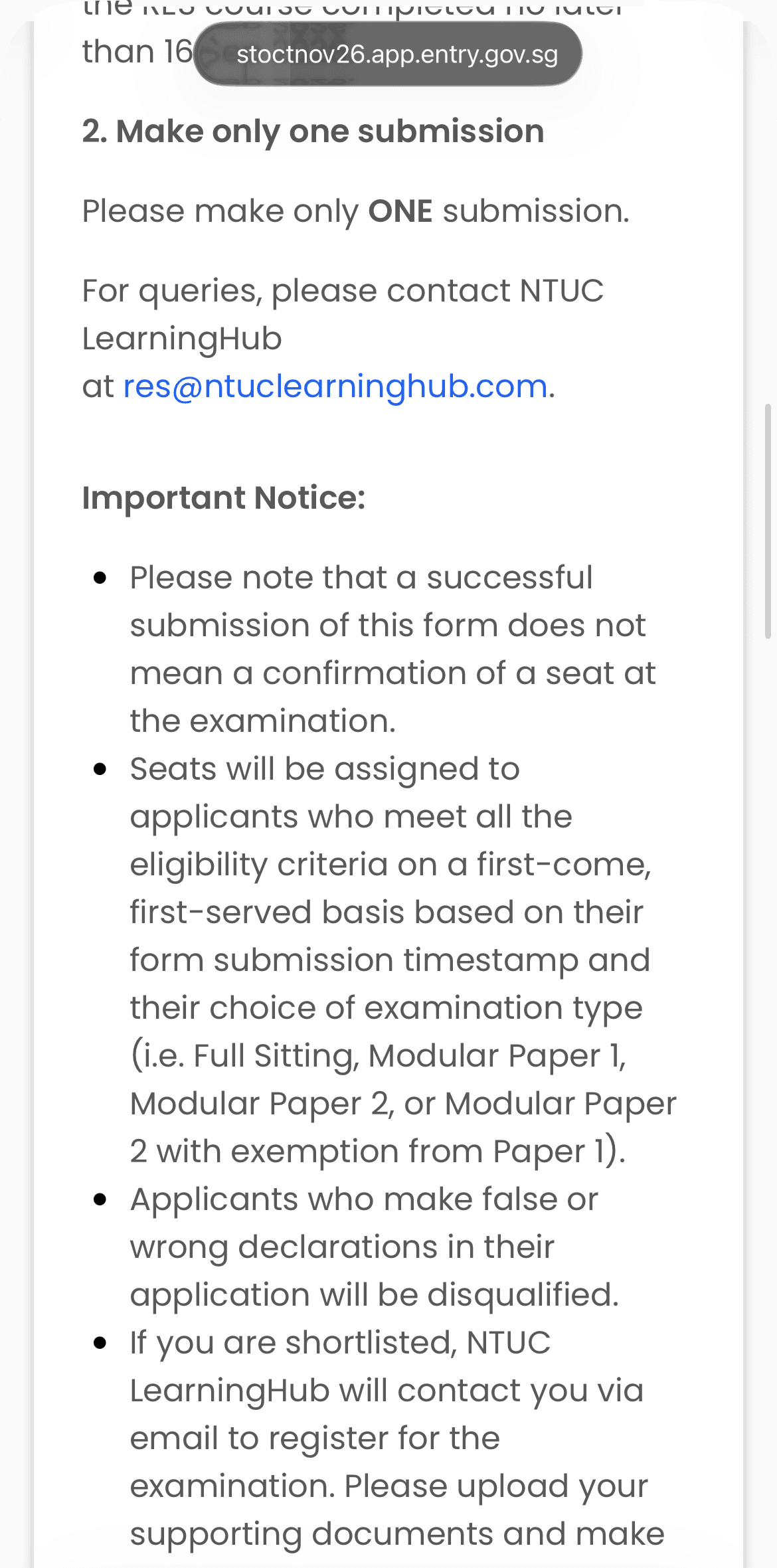
Submit once
You'll see an acknowledgement page and get an acknowledgement email. Only one submission per NRIC/FIN is allowed. If a technical problem stops you from submitting, email res@ntuclearninghub.com with screenshots, your full name and the time you tried.
Wait for the shortlist email
LHUB emails shortlisted applicants by the day before Stage 2 opens, two to three weeks after Stage 1. Submitting your interest doesn't guarantee a seat.
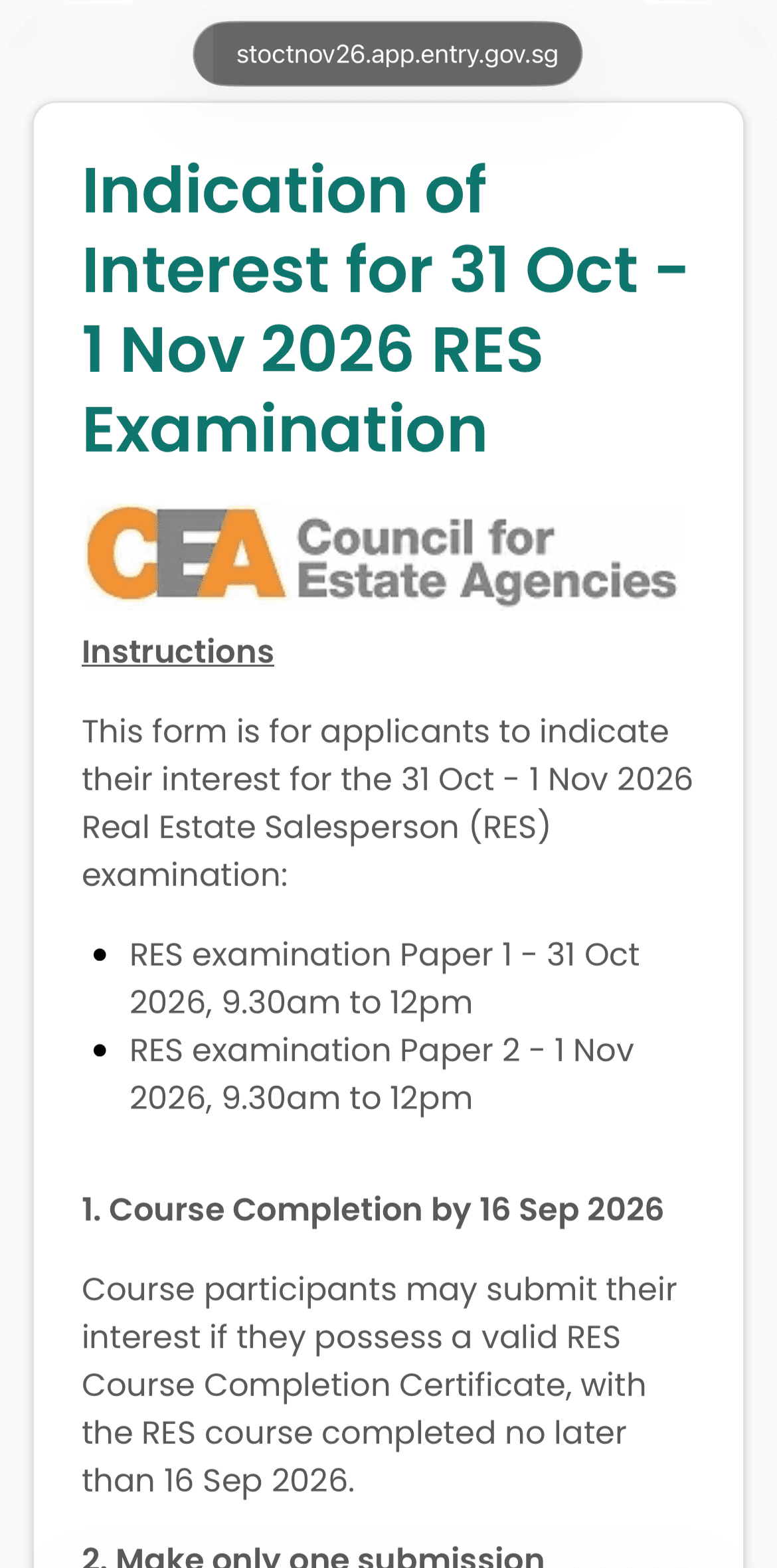
What the GovEntry form looks like
Taken during Stage 1 registration for the 31 Oct – 1 Nov 2026 exam, in September 2026. Swipe to see all four.
Stage 2: Register and Pay on NTUC LearningHub
Stage 2 is by invitation only. It runs for four days: Friday to Monday in 2027 (it was Thursday to Sunday in 2026). If you don't finish by the deadline, your seat goes to someone on the waitlist.
Get your documents ready
Have these scanned before you start:
- Certificate of RES Course Completion
- Academic qualification certificate (a colour scan)
- CEA assessment letter, if your qualification is from overseas or a private institution
- Your result slip, if you're taking one paper
- Official transcript with your graduation date, only if you're a recent NUS BSc (Real Estate) or NP Diploma in Real Estate Business graduate without your certificate yet
Files must be JPEG, PNG or PDF, under 2MB, with no spaces or special characters in the file name.
Register and pay within 30 minutes
Use the link in LHUB's email. You have 30 minutes to upload your documents and pay online. LHUB supports Chrome, Safari, Edge and Firefox. Exam fees are not refundable once paid.
Check for your confirmation
You'll see a success message and get a confirmation email and receipt, usually within a day of Stage 2 closing. If you haven't received it by the date in the infographic, email LHUB. Waitlisted applicants hear back about four to seven days after Stage 2.
Look out for your exam notification
LHUB emails your exam details and confirmation slip about five days before the exam.
RES Exam Fees
These are NTUC LearningHub's rates, unchanged since the July 2024 exam. The exam fee is separate from your course fee. For every cost from course to first year as an agent, see how much it costs to become a property agent.
Full sitting (both papers)
S$512.30 (incl. GST)
For first-time candidates, or if you failed both papers.
Modular sitting (one paper)
S$283.40 (incl. GST)
For candidates who passed one paper and are retaking the other.
Results appeal
S$87.20 (incl. GST, non-refundable)
Per appeal, for a failed paper only. See appeals below.
Deferment application
S$130.80 (incl. GST, non-refundable)
Only for hospitalisation, a death in the family or NS duty. Not refunded if rejected.
NTUC members: UTAP can cover half
The Union Training Assistance Programme (UTAP) pays up to 50% of the exam fee, capped at $250 a year. You must be a paid-up member before the exam and when you claim, and the exam can't be paid for by your company. Claim within six months of the exam with your receipt and result slip.
UTAP support for the RES exam is approved until 31 March 2027, so it covers the March 2027 sitting. Check before you claim for later sittings.
Claim on the U-Portal. See LHUB's UTAP application guide.
RES Exam Day Rules
These come from NTUC LearningHub's exam rules. Breaking them can get you disqualified, have your results voided or bar you from future exams.
Bring
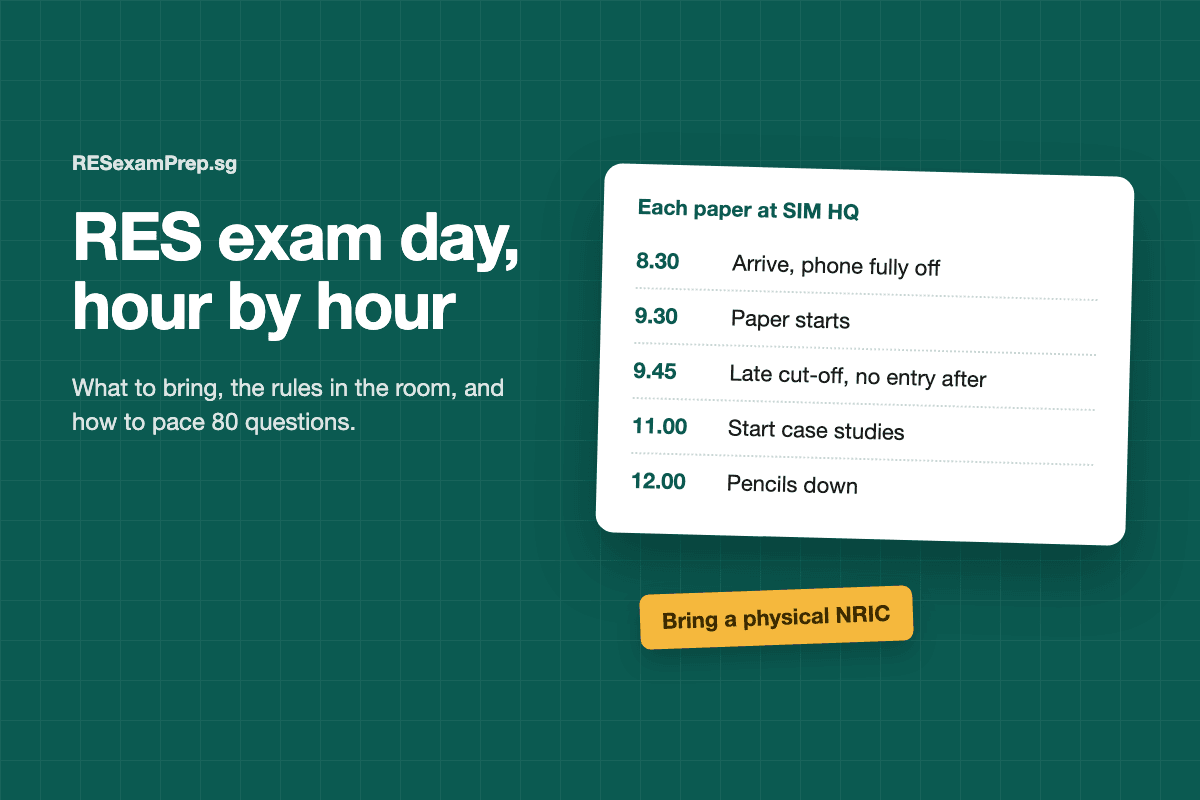
- A physical NRIC, passport, driving licence or Employment Pass. Digital IDs are not accepted.
- 2B pencils and an eraser
- A basic calculator with no wireless, text or programming functions, no cover and nothing printed on the lid. Phone calculators are not allowed.
- Plain water, if you like. No other food or drinks.
Timing
- Arrive an hour early.
- Up to 15 minutes late: you're let in 15 minutes after the start, with no extra time.
- 15 minutes or more late: you can't sit the paper, and the fee isn't refunded.
- You can't leave in the first hour or the last 15 minutes.
Switch your phone fully off
Silent or sleep mode isn't enough. Phones, smartwatches and fitness trackers go into your bag at the side of the room, with alarms turned off. If your phone rings during the exam, your bag is taken out of the room and the incident is reported to CEA. Caps and hats aren't allowed unless they're worn for religious or medical reasons.
For a packing list, the morning hour by hour and how to pace each paper, see our RES exam day guide.
RES Exam Deferment and Absence
If you don't turn up, you're marked Absent and treated as having failed. There's no refund. You can only apply to defer in three situations:
- You were hospitalised on the exam day
- A spouse, child, parent, sibling, grandparent or grandchild died within 14 days before the exam
- You had National Service duties on the exam day
An outpatient MC, or hospitalisation leave on its own, isn't accepted. Apply on LHUB's website within five working days after the exam, with supporting documents and the S$130.80 fee. If it's approved, you're moved to the next exam, and you can't defer again.
RES Exam Results and Appeals
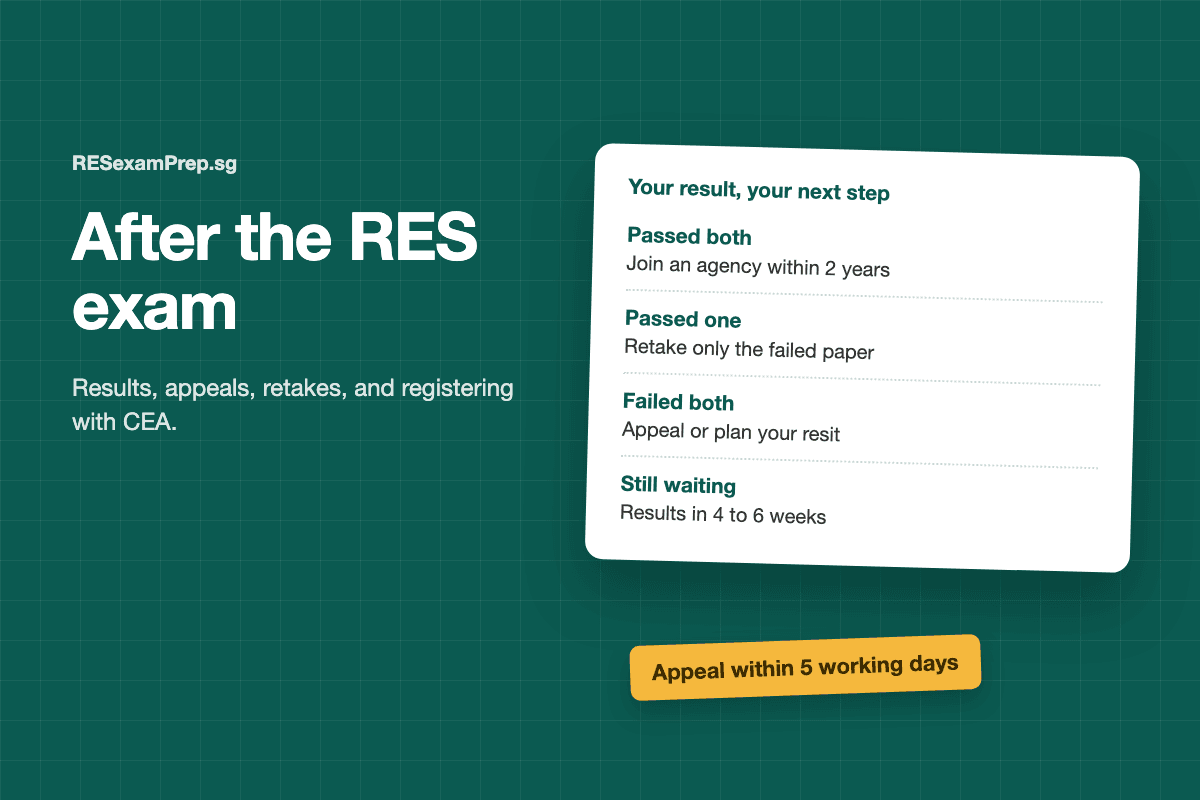
LHUB emails your Statement of Results 4 to 6 weeks after the exam. It shows Pass or Fail for each paper and overall, but not your marks. Check your spam folder too. Our guide to what happens after the RES exam covers results, appeals and CEA registration step by step.
If you pass both papers
You have two years from the date on your results to register as a salesperson. CEA's example: if you passed the November 2026 exam with results dated 15 December 2026, you must apply through an agency by 31 December 2028. After that, you redo the course and the exam.
- Choose a licensed estate agency. You can only join one at a time.
- Create a profile in CEA's ACEAS system. The agency starts your application, you complete it, and the agency submits it to CEA.
- CEA processes it in about two to three weeks.
The agency pays CEA's fees: a $60 application fee, plus $280 for registration (or $140 if you start after 30 June). You also need to be at least 21, have professional indemnity insurance, and be up to date on MediSave contributions if you're self-employed.
If you fail one or both papers
- If you passed one paper, retake only the other at a later sitting (S$283.40).
- Your pass in one paper only counts while your course certificate is valid. Once the certificate expires, you redo the course and both papers.
- Retakes from 2027 are on the 2027 syllabus.
Read our tips to pass the RES exam and practise with our free question set before your next attempt.
Appealing a result
- Only for a paper you failed.
- Apply on LHUB's website within five working days of the results, and pay S$87.20 (non-refundable).
- The marking is reviewed and your marks re-checked. You won't see your script or your score.
- The outcome comes about 14 working days after the appeal window closes, or longer if there are many appeals.
- LHUB advises waiting for the outcome before registering for the next exam.
Frequently Asked Questions
What is the passing mark for the RES exam?
The passing mark is 60 for each paper, and you must pass both Paper 1 and Paper 2. CEA says the mark is subject to its review. You won't see your actual score: results only show Pass or Fail for each paper.
What is the RES exam pass rate?
CEA sets a pass mark, not a pass rate. The latest official figure comes from a Ministry of National Development written answer in November 2020: from 2011 to 2019, about 8,000 candidates sat the exam each year and on average about 30% passed. No newer figure has been published.
When is the 2027 RES exam?
CEA has published three 2027 sittings: 13–14 March, 17–18 July and 30–31 October. Paper 1 is on the Saturday and Paper 2 on the Sunday. For March, finish your course by 19 January 2027 and indicate interest on GovEntry on 20 January. Every exam from 1 January 2027 uses the revised 2027 syllabus, retakes included.
Does my course provider register me for the exam?
No. Course providers issue your Certificate of RES Course Completion, but you register yourself, through Stage 1 on GovEntry and Stage 2 on NTUC LearningHub's website.
I finished the course under the old syllabus. Do I need a bridging course for 2027?
No. CEA says bridging courses are optional and you can self-study. Your certificate stays valid for two years from the completion date, but a bridging course does not extend that validity. You will be tested on the 2027 syllabus.
What happens if I miss the Stage 1 registration window?
You can't join Stage 2 for that sitting. Wait for the next sitting, usually 3 to 4 months later, and indicate interest when its Stage 1 opens. Make sure your certificate will still be valid on the new exam date.
How many times can I retake the RES exam?
There is no limit, as long as you sit within two years of your course completion date. If you passed one paper, you only retake the other, but that pass expires with your course certificate. Once the certificate expires, you must redo the RES course and sit both papers again.
Can I take Paper 1 and Paper 2 at different sittings?
Not on a full sitting. NTUC LearningHub says full-sitting candidates can't register for the two papers under different exam slots. You sit Paper 1 on the Saturday and Paper 2 on the Sunday of the same weekend.
Sources
For anything we haven't covered, contact NTUC LearningHub at res@ntuclearninghub.com or 6336 5482 (Mon–Fri, 8.30am–5.30pm).
- CEA: Apply for the real estate salesperson examination
- CEA: Prepare for the real estate salesperson examination
- CEA: RES examination results and appeals
- CEA: Apply for salesperson registration
- NTUC LearningHub: RES exam
- NTUC LearningHub: RES exam rules and regulations (Oct 2026)
- MND written answer on RES exam statistics (3 Nov 2020)
Got your seat? Start practising.
Practise with exam-style questions and timed mock exams for both RES papers.