How Much Does It Cost to Become a Property Agent in Singapore?
Every fee from the RES course to your yearly CEA renewal, and how many months it takes before you can close your first deal.
The fees to become a property agent in Singapore are modest. The bigger costs are time, and the months before your first commission. The figures below come from CEA, NTUC LearningHub and the course providers' own websites, checked on .
- Money, to get registered
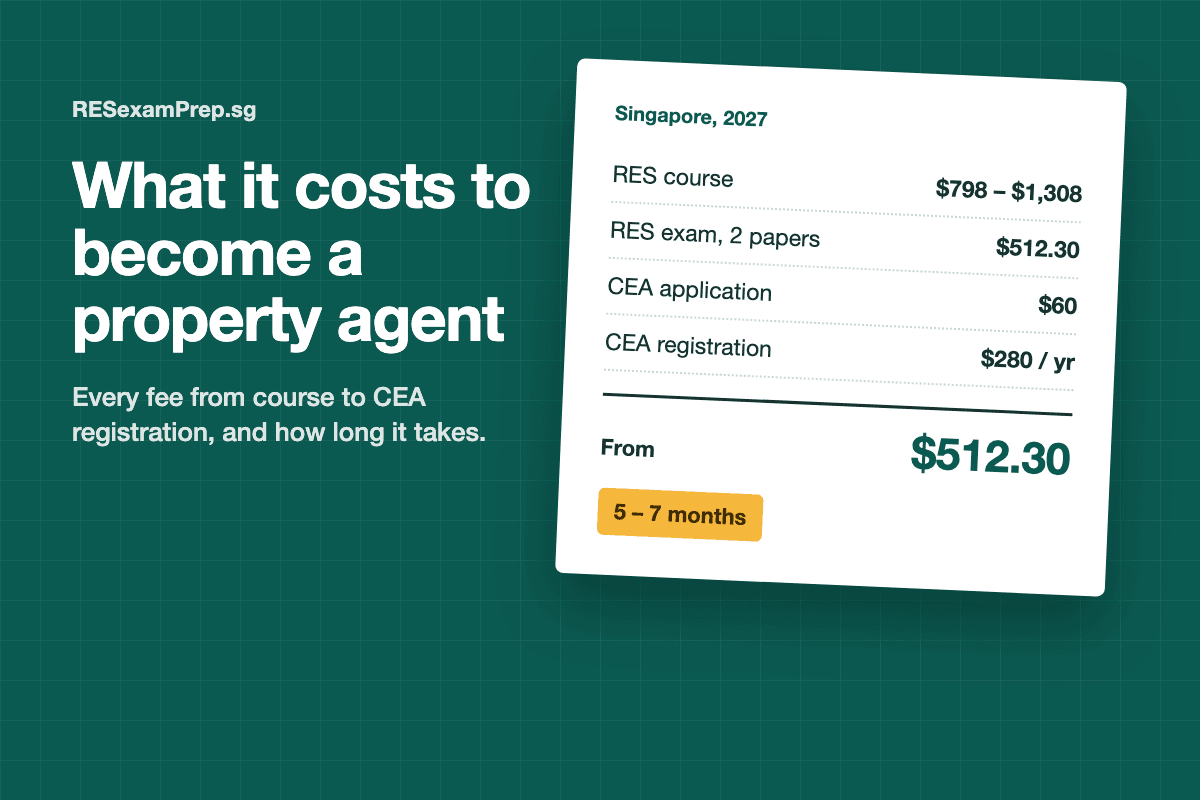
- $512.30 – $2,023.70
- Course, exam and CEA fees. Agency fees and marketing come on top.
- Time, from enrolling to your first day
- 5 – 7 months
- If you get an exam seat at the first chance and pass both papers.
First check you meet the entry criteria to become a property agent: you must be at least 21, have 4 GCE O-Level passes or equivalent, and be fit and proper.
The full bill, stage by stage
Costs fall into three stages. Lines in grey apply only to some people.
Getting qualified
Paid once, before you can work
- RES coursePaid to one of 7 CEA-approved course providers. SkillsFuture Credit can be used.
- $798 – $1,308
- RES exam, both papersPaid to NTUC LearningHub at registration. No refund.
- $512.30
- Re-sitting one paperOnly if you fail a paper. You re-sit just that paper while your course certificate is valid.
- $283.40
- Qualification assessmentOnly for overseas or private qualifications, assessed by CEA.
- $64.20
Getting registered
Paid once, when you join an agency
- CEA application feeCEA bills your agency. Some agencies absorb it; many pass it on.
- $60
- CEA registration fee, first year$140 if you start after 30 June. Billed to your agency.
- $280
- Agency joining or admin feesSet by each agency and not published. Some waive them for new agents.
- $0 – $1,000+
- Starting kitName cards, a headshot, a work phone line. Our estimate.
- $100 – $500
Staying registered
Every year you practise
- CEA registration feeCharged yearly, plus the $60 application fee once every 3 years from 2027.
- $280 a year
- MediSave contributionsCompulsory once your net trade income passes $6,000 a year. Must be up to date to renew.
- Up to 10.5% of net income
- CPD courses16 hours a year from your second year. Some agencies run courses in-house.
- Varies
- Marketing and listing portalsOptional. Paid listing packages and ads add up quickly. Our estimate.
- Low thousands a year
Course fees are list prices for one person before SkillsFuture Credit or UTAP. See every provider's fee in our RES course providers guide. CEA fees are from CEA's registration page.
What you'll actually pay: three worked totals
Your total depends mostly on which course you pick, whether you can use funding, and whether you pass both papers the first time.
Lowest
Singapore Citizen under 40 at Ngee Ann Poly, with unused SkillsFuture Credit. Passes first time. Agency covers CEA fees.
- Course after SkillsFuture funding
- $392.40
- Less SkillsFuture Credit
- −$392.40
- RES exam
- $512.30
Typical
Mid-priced course paid in cash. Passes first time. Agency passes on CEA fees.
- Course
- $888
- RES exam
- $512.30
- CEA fees
- $340
With one re-sit
As typical, but fails one paper and re-sits it at the next exam.
- Course
- $888
- RES exam
- $512.30
- Re-sit one paper
- $283.40
- CEA fees
- $340
Not included: agency joining or admin fees, your starting kit and marketing. The typical case uses a mid-priced course ($888). If you start after 30 June, the first-year CEA registration fee halves to $140.
The historical pass rate is the reason the third column exists. The only official figure is an average of about 30% a year from 2011 to 2019. Budgeting for one re-sit is sensible, even if you plan not to need it.
Six ways to pay less
- Take the course at Ngee Ann Polytechnic
- It has the highest list fee ($1,308) but is the only provider with SkillsFuture course-fee funding. Singapore Citizens under 40 pay $392.40, and Citizens 40 and above pay $152.40.
- Use your SkillsFuture Credit
- Most providers accept it against the course fee. The Mid-Career Credit cannot be used for the RES course.
- Claim NTUC UTAP if you're a member
- UTAP refunds half of unfunded fees, up to $250 a year ($500 if you're 40 or above). For the RES exam it is approved only up to 31 Mar 2027, so check before you count on it for a later sitting.
- Sign up with a friend
- BenchMark, Hastor, Pioneer and SIEA offer buddy prices, usually $40 to $88 off each.
- Ask agencies for their fee schedule in writing
- Joining fees, admin fees and who pays CEA's fees differ a lot between agencies. Compare before you sign.
- Pass both papers the first time
- Each re-sit costs $283.40 and usually pushes your start back by one sitting, about 4 months.
How long it takes: 5 to 7 months
The course itself is short. Most of the time goes to waiting: for an exam sitting, then for results, then for CEA.
Take the RES course
3 weeks – 2 months52 to 72 hours of class, depending on the provider. Intensive runs finish in about 3 weeks; evening and weekend runs take up to 2 months. You need 75% attendance.
Study for the exam
6 – 8 weeksOur guide, not a rule: about 1 to 2 hours a day on top of class. Most of it overlaps with the wait for an exam seat.
Wait for an exam sitting
About 8 weeks or moreYou must finish the course by the day before Stage 1 registration, which opens about 7 to 8 weeks before the exam. Miss the cut-off or a seat, and the next sitting is about 4 months later.
Sit both papers
One weekendPaper 1 on Saturday and Paper 2 on Sunday, 2.5 hours each, at SIM HQ in Clementi.
Wait for results
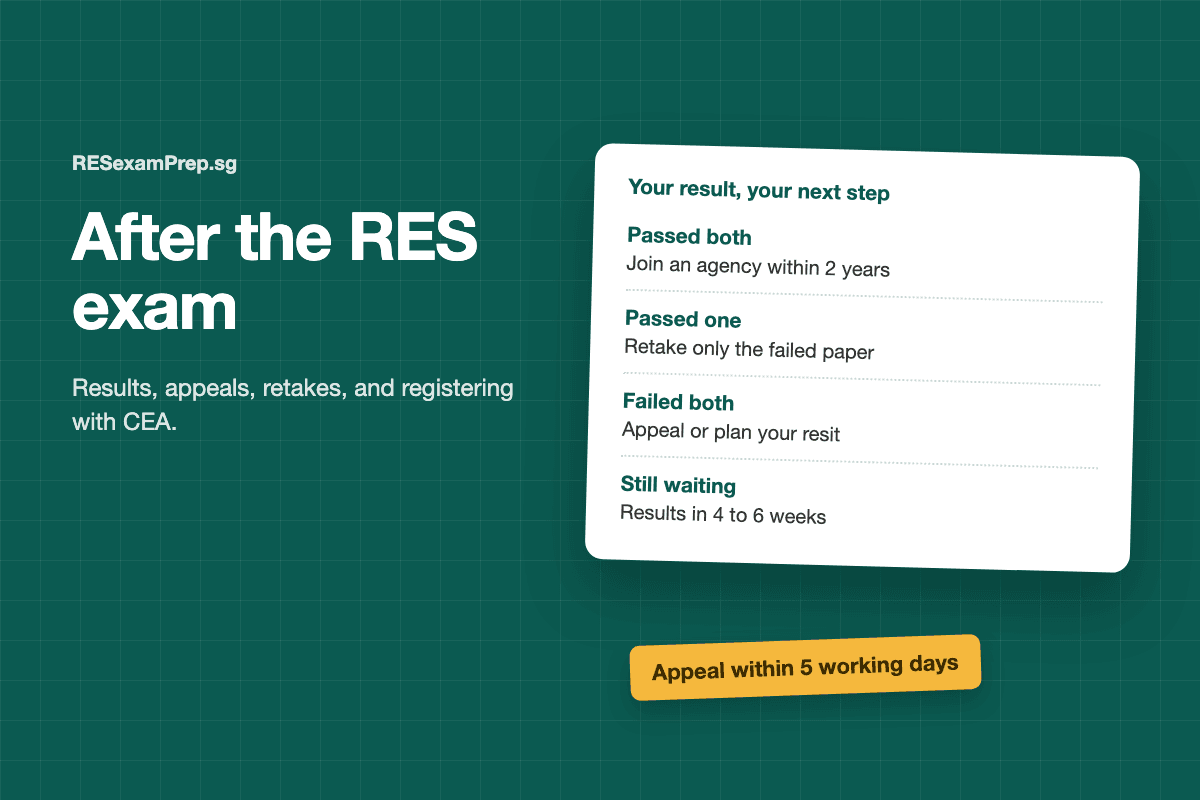
4 – 6 weeksNTUC LearningHub emails a Pass or Fail for each paper. Marks are not released.
Join an agency and register with CEA
2 – 3 weeksThe agency starts your application in CEA's system. CEA takes about 2 to 3 weeks once it is complete.
The RES exam runs three times a year (around March, July and October or November), and each sitting has about 3,000 seats, given out first come, first served. If you miss a seat, you wait for the next sitting. See the RES exam schedule and our guide to registering for the RES exam for cut-off dates.
The ongoing cost once you're an agent
No basic salary
Property agents are self-employed and paid by commission when a deal completes. Your first deal can take months, so the biggest cost for many new agents is the income they give up. Have savings to cover your living costs before you leave a salaried job.
MediSave
Once your net trade income is more than $6,000 a year, you must contribute to MediSave. In 2026 the rate on income above $18,000 is 8% to 10.5% depending on your age. For example, a 30-year-old earning $40,000 net would contribute $3,200. You must be up to date on MediSave before CEA will renew your registration. Work out your own figure with CPF's MediSave rates for the self-employed.
16 hours of CPD a year
From your second year, you must complete at least 16 hours of Continuing Professional Development (CPD) every calendar year to renew: 12 hours of structured courses and 4 hours of self-directed learning. New agents are exempt in their first CPD cycle. Details are on CEA's CPD framework page.
New from 2027: 3-year registration and the Currency Requirement
From 1 Jan 2027, CEA registration lasts 3 years instead of 1. If you join on or after that date, your registration runs to 31 December of your third year. CEA still charges the $280 registration fee every year, but the $60 application fee is now paid once every 3 years.
To renew, you must also meet a new Currency Requirement: complete at least 3 property transactions in the 3 years, or pass a Refresher Examination. New agents need no transactions in their first year, then 2 over the remaining 2 years. Rentals count, as do HDB, private, commercial and industrial deals. Source: CEA media release, 28 Jul 2026 (PDF).
Deadlines that cost you money if you miss them
- Course certificate: 2 years. You must sit the exam within 2 years of finishing the course, with no extensions. After that you pay for the course again.
- Exam pass: 2 years. You must register with CEA through an agency within 2 years of passing. After that you redo the course and the exam.
- Not turning up counts as a fail. There is no refund. Deferment ($130.80) is considered only for hospitalisation, a death in the family or NS duties. A GP medical certificate is not enough.
- Late by 15 minutes or more on exam day: you are not let in, and there is no refund.
Frequently Asked Questions
How much does it cost to become a property agent in Singapore?
From $512.30 to about $2,023.70 to get registered, plus any fees your agency charges. The RES course costs $798 to $1,308 before funding, the exam is $512.30 for both papers, and CEA charges $60 to apply and $280 a year to stay registered.
How long does it take to become a property agent in Singapore?
About 5 to 7 months from enrolling in the RES course to your first day as a registered agent, if you get an exam seat at the first sitting you're eligible for and pass both papers. Each missed seat or failed paper adds about 4 months.
Does the agency or the agent pay CEA's registration fees?
CEA bills the agency for the $60 application fee and the $280 yearly registration fee. Some agencies absorb these; others pass them on to their agents. Ask the agency before you join.
What funding can I get for the RES course and exam?
For the course, most providers accept SkillsFuture Credit, and Ngee Ann Polytechnic's course also gets SkillsFuture course-fee funding, which brings it down to $392.40 ($152.40 for Citizens aged 40 and above). For the exam, NTUC members can claim UTAP, which refunds up to half the fee, but UTAP for the RES exam is only approved up to 31 Mar 2027.
Do property agents get a basic salary?
No. Property agents in Singapore are self-employed and earn commission on completed deals, so plan for a period with little or no income while you build clients. You also pay your own MediSave contributions once your net trade income passes $6,000 a year.
What changes for property agents from 2027?
From 1 Jan 2027, CEA registration lasts 3 years instead of 1, but the registration fee is still charged every year. To renew, agents must complete at least 3 transactions in the 3 years or pass a Refresher Examination. New agents need no transactions in their first year, then 2 over the remaining 2 years.
Make the $512.30 count
Every failed paper costs $283.40 and about 4 months. Practise with questions in the real exam format before you sit.