Check Your Eligibility: Entry Criteria to Become a Property Agent in Singapore (2027)
Every requirement to become a real estate salesperson in Singapore, and the point at which each one is checked, so you know you qualify before you pay for the course.

Most of the rules for becoming a property agent are checked at the very end, when an agency applies to register you with the Council for Estate Agencies (CEA). By then you've already paid for the course and the exam, and neither is usually refundable. So check them all now.
A note on wording: CEA licenses estate agencies and registers salespersons. As an agent, you hold a registration, not a licence. It's a distinction that comes up in Paper 1.
When Each Requirement Is Checked
There are three checkpoints between you and your first day as an agent. Here's what each one looks at.
Finish the RES course
Checked by your CEA-approved course provider
- At least 75% attendance, to get the Certificate of RES Course Completion
- Ngee Ann Polytechnic also requires you to pass two assessments
Register for the RES exam
Checked by NTUC LearningHub, which runs the exam for CEA
- A course certificate dated within the last 2 years
- Proof of education: 4 O-Level passes or equivalent, or CEA's assessment letter for overseas or private qualifications
Register with CEA through an agency
Checked by CEA, after a licensed estate agency submits your application
- A pass in both papers (or an exemption), within the last 2 years
- At least 21 years old
- Fit and proper, with all past convictions declared
- Not a key executive officer of another agency, and not tied to a licensed moneylender
- Professional indemnity insurance and MediSave contributions up to date
- Extra documents if you're a PR of under 10 years or a foreigner
Check everything before you sign up for the course
Your education level is checked when you register for the exam. Your age, record and residency documents aren't checked until after you pass. If any of these could be a problem, settle it with CEA before you pay for the course.
Age
You must be at least 21 years old to register as a salesperson. CEA lists this as a registration requirement. Its course and exam pages don't set a minimum age, so check with your course provider if you're younger than 21 and want to start early.
Citizens, PRs and Foreigners
You don't have to be a Singapore Citizen. PRs and foreigners can register too. What changes is the paperwork CEA asks for when you register.
| You are a | What CEA needs from you |
|---|---|
| Singapore Citizen | Nothing extra. |
| Permanent Resident for 10 years or more | Nothing extra. |
| Permanent Resident for under 10 years | Either a Certificate of No Criminal Conviction from your country of origin, issued within 3 months of your application, or documents showing you've lived in Singapore for 10 years or more, such as local school certificates, IRAS statements or past work or long-term visit passes. |
| Foreigner | Your agency asks CEA for a preliminary assessment first, with your employment contract (a draft is fine) and work pass. If you don't have a work pass yet, the agency can check which one you'd qualify for with MOM's Self-Assessment Tool. CEA takes 2 to 3 weeks once it has everything. |
Education
You need at least 4 GCE O-Level passes, or an equivalent. NTUC LearningHub, which runs the exam, says the passes can come from at most 2 sittings. It accepts these as equivalent:
- 4 GCE A-Level passes
- Higher NITEC
- A diploma from SP, NP, NYP, TP or RP
- A degree from NUS, NTU, SMU, SUTD, SUSS or SIT
- WPLN Level 5 or above in all five parts (see below)
You prove this twice: you upload a colour scan of your certificate when you register for the exam, and CEA checks it again when you register as a salesperson.
No O-Levels? Take the WPLN assessments
CEA accepts the Workplace Literacy and Numeracy (WPLN) assessments, run by the British Council, in place of O-Levels. You need Level 5 or above in all five parts: Reading, Listening, Speaking, Writing and Numeracy. A Level 4 in any one part means you don't qualify yet. You can book a session on the British Council's WPLN page.
Overseas or private qualifications
Qualifications from overseas or from private schools need CEA's approval. You apply to CEA directly, not through your course provider:
- Fill in CEA's Educational Qualification Assessment form.
- Email it with your certificates, transcripts and any other supporting documents to licensing@cea.gov.sg. Notarised copies aren't accepted, and a Chinese bachelor's degree or higher needs CHSI or CDGDC verification if you don't have the originals.
- CEA replies in about 15 working days. Its assessment letter is valid for 3 years, and you upload it when you register for the exam.
Send it before your course ends
You can't register for the exam without CEA's letter. You upload it about 2 weeks after the course cut-off date, and CEA takes about 3 weeks (15 working days) to reply. Send your documents to CEA as soon as you sign up for the RES course, so the letter is ready in time.
Qualifications That Exempt You From the Exam
Some real estate degrees and diplomas count towards the exam, or replace it entirely. Whether you skip one paper or both can depend on when you started the degree or diploma.
| Qualification | What it gets you |
|---|---|
| NUS Bachelor of Business Administration (Real Estate) | Exempt from Paper 1. Take the partial RES course for Paper 2, then sit Paper 2. |
| NUS BSc (Real Estate) or NP Diploma in Real Estate Business, enrolled on or after 1 April 2020 | Exempt from Paper 1. Take the partial RES course for Paper 2, then sit Paper 2. |
| NUS BSc (Real Estate) or NP Diploma in Real Estate Business, enrolled before 1 April 2020 | Exempt from the course and both papers. |
| Discontinued courses: NUS BSc (Estate Management), NUS Bachelor of Real Estate (Property Management or Valuation), NP Diploma in Building Management or Building & Real Estate Management, SP Diploma in Property Development & Facilities Management or Building & Property Management | Exempt from the course and both papers. |
| Passed all three RICS General Practice exams on or before 1 March 2023 | Counts as a pass in the RES exam. RICS membership on its own doesn't. |
An exemption covers the exam only. You still need to meet every other requirement on this page to register.
The Course and the Exam
- Only a CEA-approved course counts. You need at least 75% attendance to get the Certificate of RES Course Completion. Our guide to the 7 approved course providers compares fees and schedules.
- The certificate lasts 2 years. You must sit the exam within 2 years of the date on it. CEA doesn't extend it. After that, you take the course again.
- A seat isn't guaranteed. Each sitting has 3,000 seats, given out first come, first served. CEA warns that not everyone with a valid certificate will get one. See how to register for the RES exam.
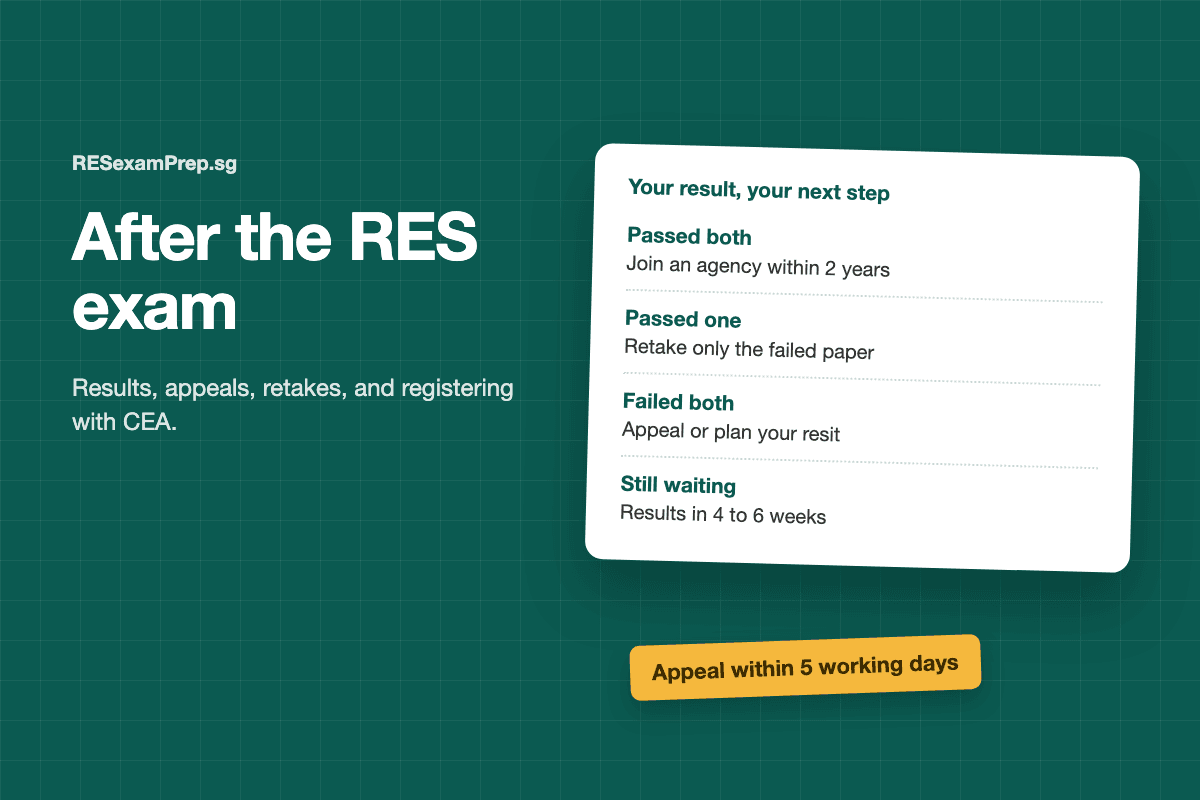
- Your pass also lasts 2 years. An agency must apply to register you within 2 years of passing, or you redo the course and the exam.
Fit and Proper
CEA must be satisfied that you're fit and proper under the Estate Agents Act. It looks at all the facts, but you're treated as not fit and proper, unless CEA decides otherwise, if:
- You've been convicted of an offence involving dishonesty or fraud.
- A civil court has found against you for fraud, dishonesty or breach of fiduciary duty.
- You've been convicted of an offence involving money laundering, proliferation financing or terrorism financing, in Singapore or elsewhere.
- You've been convicted of any offence under the Estate Agents Act.
- You're an undischarged bankrupt, or you've made a composition or arrangement with your creditors.
- CEA decides you're not fit and proper after looking at any other relevant facts.
You must declare every past conviction, from a court in Singapore or any other country, military courts included. CEA gives an example: someone previously detained under the Misuse of Drugs Act, or held under a detention or police supervision order under the Criminal Law (Temporary Provisions) Act, would generally not be fit and proper, unless CEA decides otherwise after looking at the circumstances.
Not sure about your record?
"Unless CEA decides otherwise" means a past conviction isn't an automatic bar, but it isn't checked until you apply to register. Ask CEA about your situation before you pay for the course and exam.
Joining an Agency and Registering
You can't register with CEA on your own. A licensed estate agency applies for you. You create a profile in CEA's ACEAS system, the agency starts the application, you fill it in, and the agency submits it. CEA takes about 2 to 3 weeks once it has everything. These requirements apply at this stage:
- One agency at a time. You can't register with more than one.
- Not a key executive officer (KEO) of another agency. If you are one, resign from that role first.
- No ties to a licensed moneylender. You can't hold a moneylender's licence or be an employee, director or partner of a licensed moneylender.
- Professional indemnity insurance valid for at least a year from the day your registration starts. This is arranged at agency level, so ask your agency how you're covered.
- MediSave up to date. Agents are self-employed, so you pay your own MediSave contributions. CEA only processes your application if they're paid in full or on an active GIRO plan with CPF Board. Check on CPF's Self-employment dashboard with Singpass.
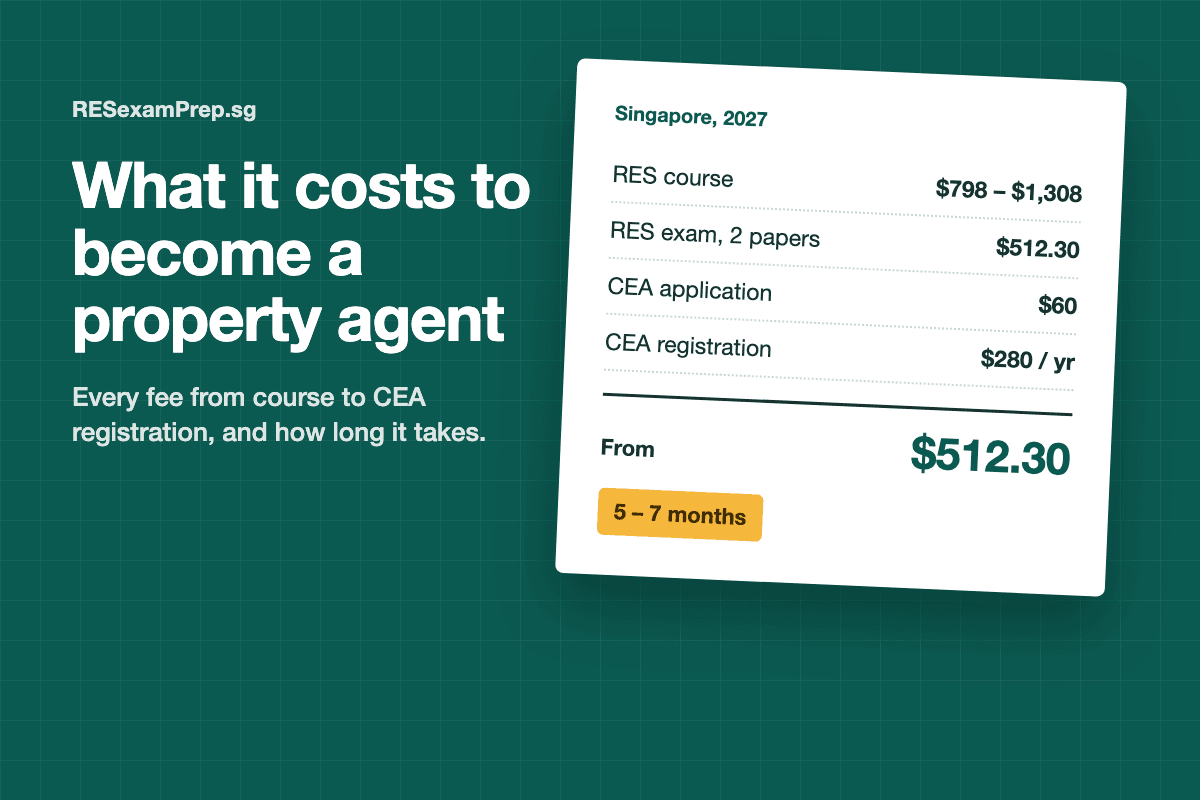
CEA charges a $60 application fee and a registration fee of $280 (or $140 if your registration starts after 30 June). The agency pays them to CEA, and they aren't refundable. Whether the agency passes them on to you is up to the agency. Our cost breakdown covers every fee from course to first renewal.
What Changes in 2027
The entry criteria themselves aren't changing. What changes is what you study and what it takes to stay registered.
- New exam syllabus. Every exam from 1 January 2027 uses the 2027 syllabus, retakes included. A course certificate from 2026 stays valid for its 2 years, and bridging courses are optional. See what's changed in the 2027 syllabus.
- Registration lasts 3 years. If you join on or after 1 January 2027, your registration runs from the day you join to 31 December of the third year. The $60 application fee is charged once per 3-year cycle; the $280 fee is still charged every year.
- A new Currency Requirement. To renew, agents need at least 3 property transactions over the 3 years, or a pass in a Refresher Examination. New agents get their first year free of this, then need 2 transactions over the remaining 2 years, or the Refresher Exam.
- Training every year. You're exempt from Continuing Professional Development (CPD) in your first cycle. After that, you need at least 16 hours a year.
Our guide to what to do after the RES exam covers registration timing in more detail.
Meet the Criteria? Here's What's Next
- Pick a course provider and intake: CEA-approved RES course providers compared.
- Plan your exam registration: how to register for the RES exam.
- Budget for it: how much it costs to become a property agent.
- Start practising early. The only official pass-rate figure is about 30% a year on average (2011 to 2019), so preparation matters. Try free RES practice questions.
Frequently Asked Questions
Can foreigners become property agents in Singapore?
Yes. You need a valid work pass and an agency willing to employ you. The agency asks CEA for a preliminary assessment with your employment contract and work pass, which takes 2 to 3 weeks. You also need to meet every other requirement, including the RES course and exam.
Do I need to be a Singapore PR for 10 years?
No. PRs of under 10 years can register too. They just send CEA a Certificate of No Criminal Conviction from their country of origin (issued within 3 months), or proof that they've lived in Singapore for 10 years or more.
What if I don't have 4 O-Level passes?
Take the Workplace Literacy and Numeracy (WPLN) assessments through the British Council. CEA accepts Level 5 or above in all five parts (Reading, Listening, Speaking, Writing and Numeracy) instead of the O-Levels. A Level 5 in four parts and a Level 4 in the fifth doesn't count.
Can I use an overseas degree or a private diploma?
Possibly. Email your certificates, transcripts and the Educational Qualification Assessment form to licensing@cea.gov.sg. CEA takes about 15 working days. If it accepts them, you upload its assessment letter when you register for the exam.
Is there a minimum age to take the RES course?
CEA's minimum age of 21 is a requirement for registering as a salesperson. CEA's course and exam pages don't set an age for the course itself, but a provider may set its own, so ask before you enrol. Either way, you can't start work as an agent until you're 21.
Will a criminal record stop me from becoming a property agent?
Not always. Convictions for dishonesty, fraud, money laundering, terrorism financing or an offence under the Estate Agents Act make you not fit and proper unless CEA decides otherwise. You must declare every past conviction, in Singapore or overseas, including military court ones. If you're unsure, ask CEA before you pay for the course.
Do I need to pay my MediSave before I can register?
Yes. CEA only processes your registration if your MediSave contributions are up to date, either paid in full or on an active GIRO plan with CPF Board. You can check on CPF's Self-employment dashboard with Singpass.
I used to be an agent. Do I need to retake the course?
Only if you've been out of the industry for more than 2 years. If it's 2 years or less, you make up the CPD hours you would have done, then apply again.
How long does the RES course take?
52 to 72 class hours, depending on the provider. That's about 3 weeks on an intensive schedule or up to 2 months part-time. Your certificate lets you sit the exam for 2 years from its date, with no extensions.
Sources
CEA's registration and course pages were checked on 11 November 2026, the others on 9 November 2026. Rules can change, so confirm on CEA's site before you act.
- CEA: Apply for salesperson registration (updated 5 Mar 2026)
- CEA: Real estate salesperson course and exempt qualifications (updated 4 Aug 2026)
- CEA: Prepare for the RES examination (RICS, exemptions)
- CEA: Renewal of salesperson registration (updated 1 Oct 2026)
- CEA media release: licence and registration validity extended, Currency Requirement (28 Jul 2026)
- CEA: Educational Qualification Assessment form (PDF)
- NTUC LearningHub: RES exam eligibility and registration
- British Council: WPLN assessments
Eligible? Get a Head Start on the Exam
Practice questions and timed mock exams for both RES papers, so you start the course already knowing the topics.