RES Exam Day Guide: What to Bring, the Rules and Tips to Do Your Best
Months of study come down to two mornings at SIM HQ. Here is what to pack, how the morning runs, the rules that can cost you a paper, and how to pace and answer for the most marks. Rules checked against NTUC LearningHub and CEA on 9 Nov 2026.
Most of what decides your RES result happens in the months before the exam. But exam day can still take marks away: a forgotten NRIC, a train delay that puts you past the 15-minute cut-off, a phone alarm, or a run of tough questions that eats the time you needed for the case studies. This guide covers each of these.
It assumes you already have your seat. If you haven't registered yet, start with our RES exam registration guide. For study strategy in the months before, see 5 tips to pass the RES exam the first time.
Exam Day at a Glance
- When
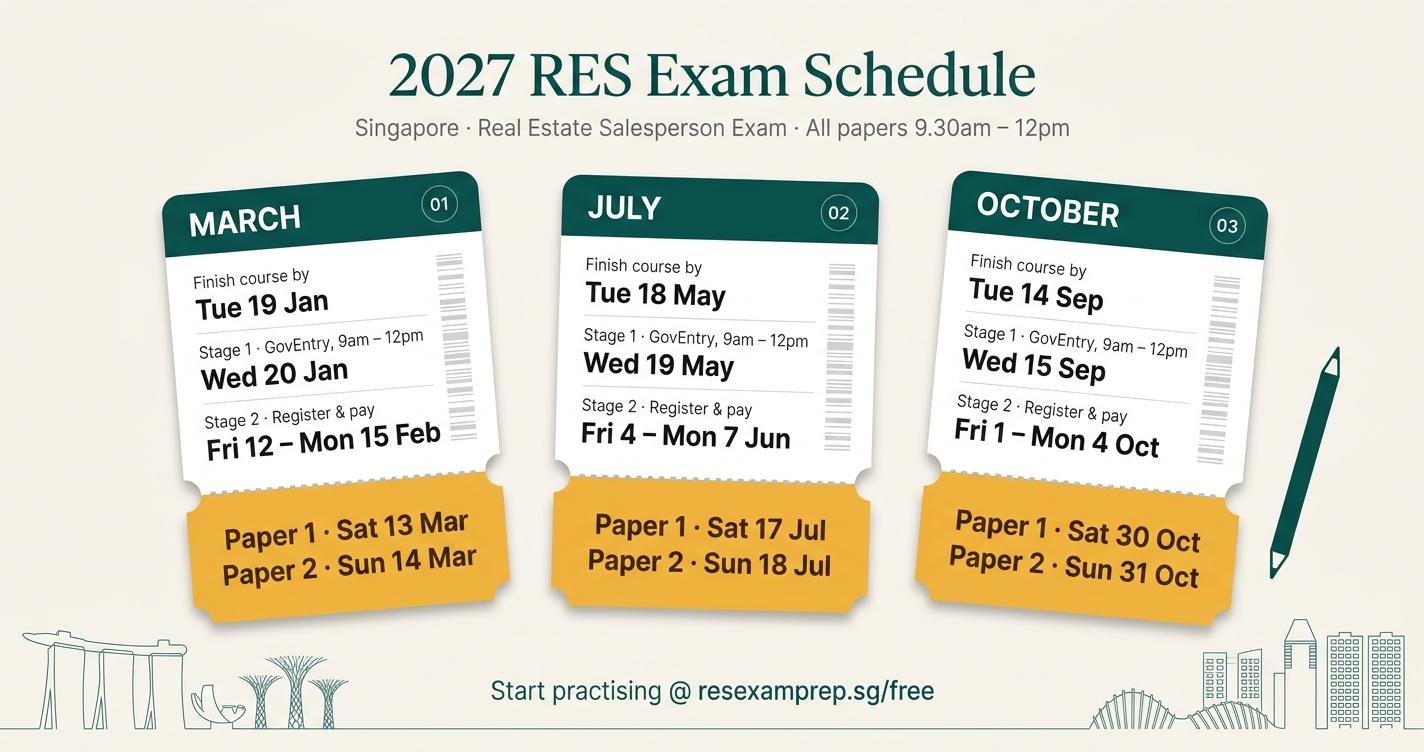
- Paper 1 on Saturday, Paper 2 on Sunday, 9.30am to 12pm both days
- Where
- SIM HQ, 461 Clementi Road, Singapore 599491 (paper-based)
- Arrive by
- 8.30am, an hour before the start
- Late cut-off
- 9.45am. Any later and you can't sit the paper.
- Each paper
- 80 multiple-choice questions, 100 marks, 150 minutes
- Pass mark
- CEA publishes 60 per paper, subject to its review. You must pass both.
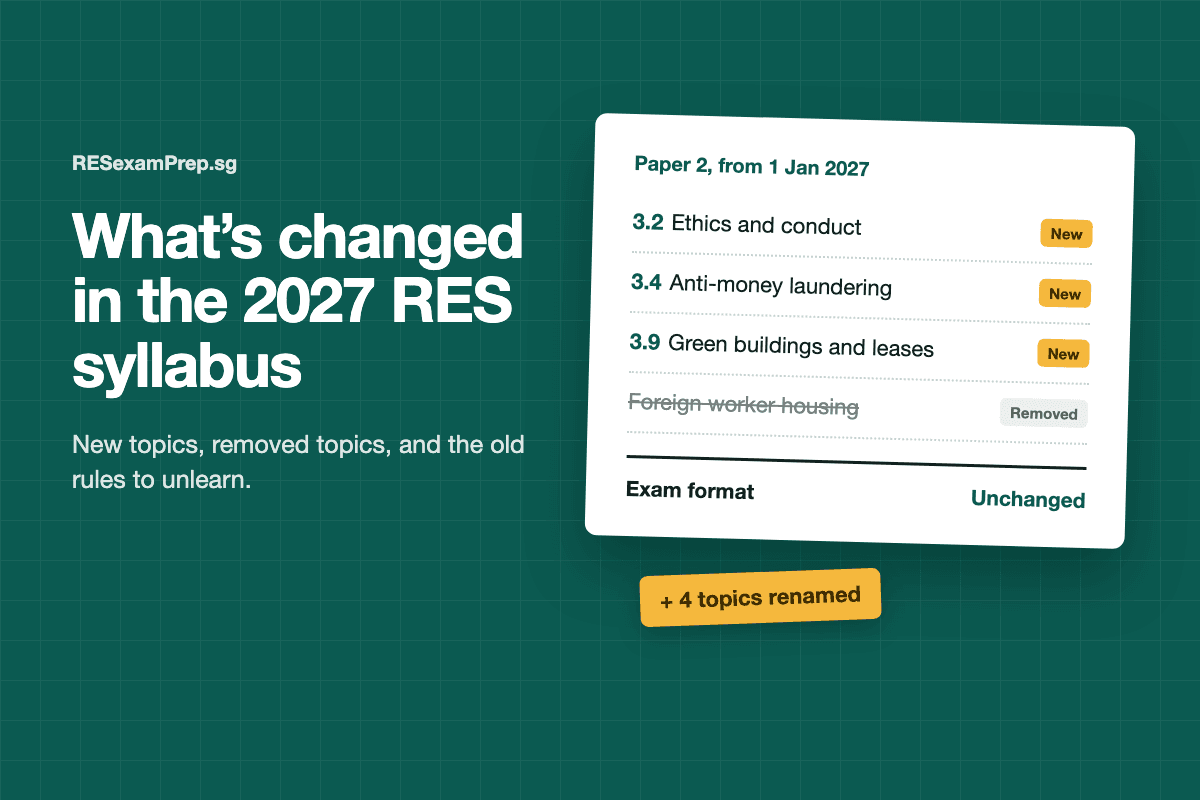
Your exam details and confirmation slip arrive by email from NTUC LearningHub about five days before the exam. Every sitting from 1 January 2027 follows the revised 2027 syllabus; the format and timing stay the same.
The Week Before
Rehearse the real thing, at the real time
Do one full timed mock starting at 9.30am on the weekend before: Paper 1 on Saturday, Paper 2 on Sunday. Use the calculator you'll bring, keep your phone in another room, and drink only water. You find out whether your breakfast holds for 2.5 hours and whether your pacing works, while there is still time to fix it.
Stop learning new topics two or three days out
Switch to one or two pages of the facts you keep forgetting: penalty amounts, ABSD and BSD rates, loan limits, deadlines and time periods. Read them each morning. New material this late mostly crowds out what you already know.
Know which recent changes won't be tested
CEA doesn't test government policy changes announced or brought in within one month before the exam. If a rule changed in the last month, answer by the rule that applied before it.
Check your confirmation email
When it arrives, check your name, the exam type (full sitting or one paper) and the dates. If anything is wrong, email res@ntuclearninghub.com that day, not on the Friday night.
What to Bring (and Where It Goes)
Pack the night before. Everything you bring ends up in one of two places: on your desk, or in your bag at the designated area of the room.
On your desk
- Physical NRIC, passport, driving licence or Employment Pass. Digital IDs such as Singpass are not accepted.
- 2B pencils, sharpened, plus a spare
- An eraser that erases cleanly
- A calculator with no wireless, text, programming or printing functions. Take the cover off at home, and make sure no formulae are printed on the lid.
- Plain water. The bottle stays on the floor next to your seat.
- A jacket or cardigan, in case the room is cold
In your bag, at the side of the room
- Your phone, powered off completely, with alarms off. Silent or sleep mode isn't enough.
- Smartwatch and fitness tracker
- Notes, books and any printouts
- Wallet and everything else
- Caps and hats, unless worn for religious or medical reasons
Leave valuables at home. NTUC LearningHub isn't liable for lost or damaged belongings.
Practise with the calculator you'll bring
Your phone can't be your calculator. If you've been working out stamp duty on your phone, switch now. Know how your calculator handles percentages and long figures like $1,280,000, and put in a fresh battery.
The Morning, Hour by Hour
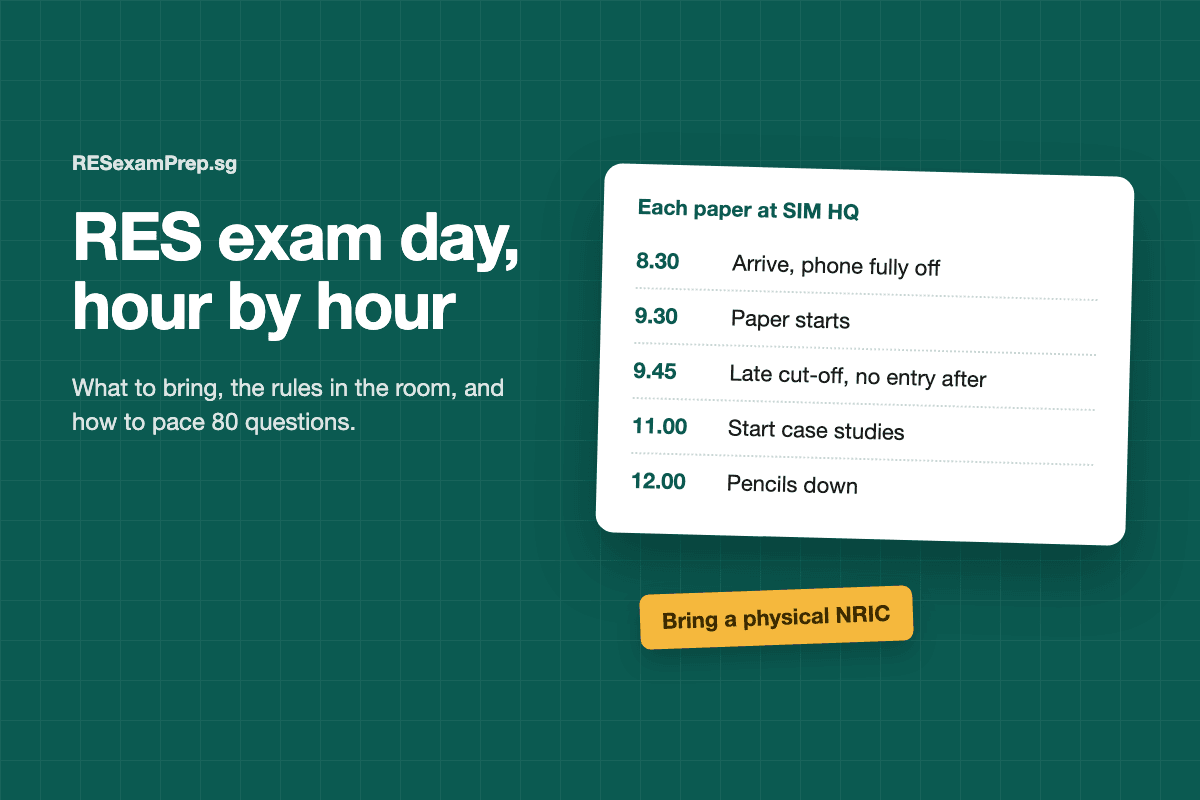
Times marked Rule come from NTUC LearningHub's exam rules. The rest are our suggestions, so shift them to suit your journey.
- 6.30am
Wake up and eat a breakfast you know
Eat what you ate before your practice mocks, not something new. Go easy on coffee: you can only use the washroom with permission, and you get no extra time for it.
- 7.30am
Leave home
Work back from an 8.30am arrival. Paper 1 is on a Saturday and Paper 2 on a Sunday, when trains and buses run less often than on weekdays.
- 8.30am
Arrive at SIM HQRule
NTUC LearningHub asks candidates to arrive an hour early. Use the washroom, then find your room and seat on the seating plan outside the room. Inside, put your bag at the designated area with your phone powered off before you go to your desk. Take only your ID, pencils, eraser, calculator and water.
- 9.30am
The paper startsRule
Don't turn the question paper over or write anything until the invigilator says so. You sign the attendance sheet after the paper starts.
- 9.45am
Late cut-offRule
If you arrive within 15 minutes of the start, you are let in at 9.45am with no extra time. Arrive 15 minutes or more late and you can't sit the paper, and the fee isn't refunded.
- 10.30am
Earliest you can leaveRule
No one may leave in the first hour. Once you hand in your answer sheet and walk out, you can't come back in. Stay and use the time.
- 11.45am
Last 15 minutesRule
No one may leave from here on. This is your final check of the answer sheet (see pacing).
- 12pm
Pencils downRule
Stop writing the moment you're told to. Writing after that counts as misconduct. Stay seated until every paper is collected and you are dismissed. Dismissal may be staggered.
Getting to SIM HQ
SIM HQ is at 461 Clementi Road, Singapore 599491. SIM lists these ways in:
- MRT: King Albert Park, Clementi or Dover
- Bus: 52, 61, 74, 75, 151, 154 or 184
- Car: parking on campus is $1.32 an hour, charged in 30-minute blocks, from 6am daily except public holidays
If you've never been to SIM, plan the walk from the station or bus stop on a map the night before. Hundreds of candidates arrive at the same time, so the last few minutes to your room can take longer than you expect.
Pacing 80 Questions in 2.5 Hours
Each paper has 60 Section A questions worth 1 mark each and 20 Section B case-study questions worth 2 marks each. Section B is a quarter of the questions but 40% of the marks, so it must never be the part you rush. Write these checkpoints at the top of your question paper once the exam starts:
| Clock | Where you should be | Notes |
|---|---|---|
| 9.30am | Start Section A60 questions, 1 mark each | 60 questions, 1 mark each |
| 10.15am | Around question 30Halfway through Section A | Halfway through Section A |
| 11am | Start Section B20 case-study questions, 2 marks each | 20 case-study questions, 2 marks each |
| 11.40am | Section B doneGo back to flagged questions | Go back to flagged questions |
| 11.50am | Answer sheet checkOne answer on every line, numbers lined up | One answer on every line, numbers lined up |
That works out to about 1.5 minutes for each Section A question and 2 minutes for each case study question, including reading, with 20 minutes left to review.
Or start with Section B
Some candidates do the case studies first, from 9.30am to about 10.10am, while they're fresh, then Section A. If a hard Section A question then runs you short, you lose 1 mark instead of 2. Try both orders in your mocks and pick the one that gets you the higher score. Don't switch on the day.
If you're running behind
At 11am with Section A unfinished, stop. Do Section B, then go back. Before the last 10 minutes, put an answer on every line, even for questions you haven't read.
How to Answer for More Marks
You don't need full marks
CEA's published pass mark is 60 per paper, but CEA reviews it and you never see your actual score, so treat 60 as a guide, not a target to scrape past. Aim for about 75 in your mocks. Even that leaves room to drop 25 marks, say 11 Section A questions and 7 case-study questions. A hard question is not a sign you're failing. Everyone in the room gets some wrong. Flag it and move on.
Use two passes
On the first pass, answer what you can. If a question takes more than about two minutes, mark your best guess, circle the question number on the question paper, and move on. On the second pass, go back to the circled ones only. A guess already on the answer sheet protects you if time runs out.
Read the last line of the question first
RES questions often set out a long scenario and then ask something narrow. Reading the question first tells you which facts matter. Underline words that flip the answer: NOT, EXCEPT, only, first, most appropriate. The rules only stop you writing on the question paper before the exam starts, so mark it up freely once it begins.
Break down “(i) and (iii) only” questions
Many questions list three or four statements and ask which combination is correct. Mark each statement true or false on its own, then cross out every option that includes a false one. You often only need to be sure about two statements to get down to one option.
Pull the facts out of case studies
Before you answer, note the details that change the rules: each buyer's citizenship, how many properties they already own, their ages and incomes, the flat type, prices and dates. Most case-study mistakes come from misreading one of these, not from not knowing the rule.
Work calculations on paper, then check them
For stamp duty, loan and grant questions, write each step on the question paper and key the numbers in twice. If your answer isn't one of the options, check the rate you used and the number of zeros before you start over. Want to drill these first? Try our ABSD calculator against your own working.
Never leave a question blank
CEA and NTUC LearningHub publish no penalty for wrong answers. A blank always scores zero, while a guess has at least a one in four chance, and better once you rule out an option or two.
Change an answer only for a reason
On review, change an answer when you can say why the first one was wrong: you misread a fact, or you've now remembered the rule. Don't change it on a vague feeling.
Keep the answer sheet lined up
Only the answer sheet is marked. When you skip a question, check that your next answer goes on the right line. One skipped line can shift a whole block of answers. Transfer answers as you go, or every page, rather than all at the end. In the last few minutes, check that every question has exactly one answer and that changed answers are fully erased.
If your mind goes blank
Put the pencil down, breathe out slowly a few times, and skip to a question you find easy. Getting a few right brings your memory back. Then return to the one that stuck.
Between Paper 1 and Paper 2
Paper 2 is the next morning, so Saturday afternoon matters. Results are Pass or Fail for each paper, and a bad feeling about Paper 1 tells you nothing about Paper 2.
- Don't compare answers. Skip the group chat post-mortem. You can't change Paper 1, and a debate over one question can shake your confidence for Paper 2.
- Eat, rest, then do a light review. Read your Paper 2 summary notes for an hour or two: CEA rules on conduct and advertising, HDB eligibility and grants, stamp duty rates and loan limits. Don't start a full mock.
- Repack. Put your ID back in the bag, sharpen your pencils and check your calculator.
- Sleep at your usual time. Same alarm, same breakfast, same route.
Sitting only one paper? The same morning plan applies.
When Things Go Wrong
You're running late
Keep going. Up to 15 minutes late, you can still sit the paper from 9.45am, with no extra time. Use the pacing checkpoints and leave the review time out.
You forgot your ID
You need a physical NRIC, passport, driving licence or Employment Pass, and a digital ID isn't accepted. If you notice early enough, go home for it or ask someone to bring it. This is the main reason to arrive an hour early.
You're sick
Missing a paper counts as a fail, and an outpatient MC isn't grounds to defer. Deferment is only for hospitalisation on the exam day, a death in the immediate family within 14 days before, or NS duty, and you apply within five working days after the exam. If you can sit, sit. See deferment rules.
Your phone was still on
If it rings or an alarm goes off in your bag, the bag is taken outside and the incident is reported to CEA. Switch it off fully at the door, not at your desk. Using it, taking photos or talking to others can get you disqualified and barred from future exams.
After the Exam
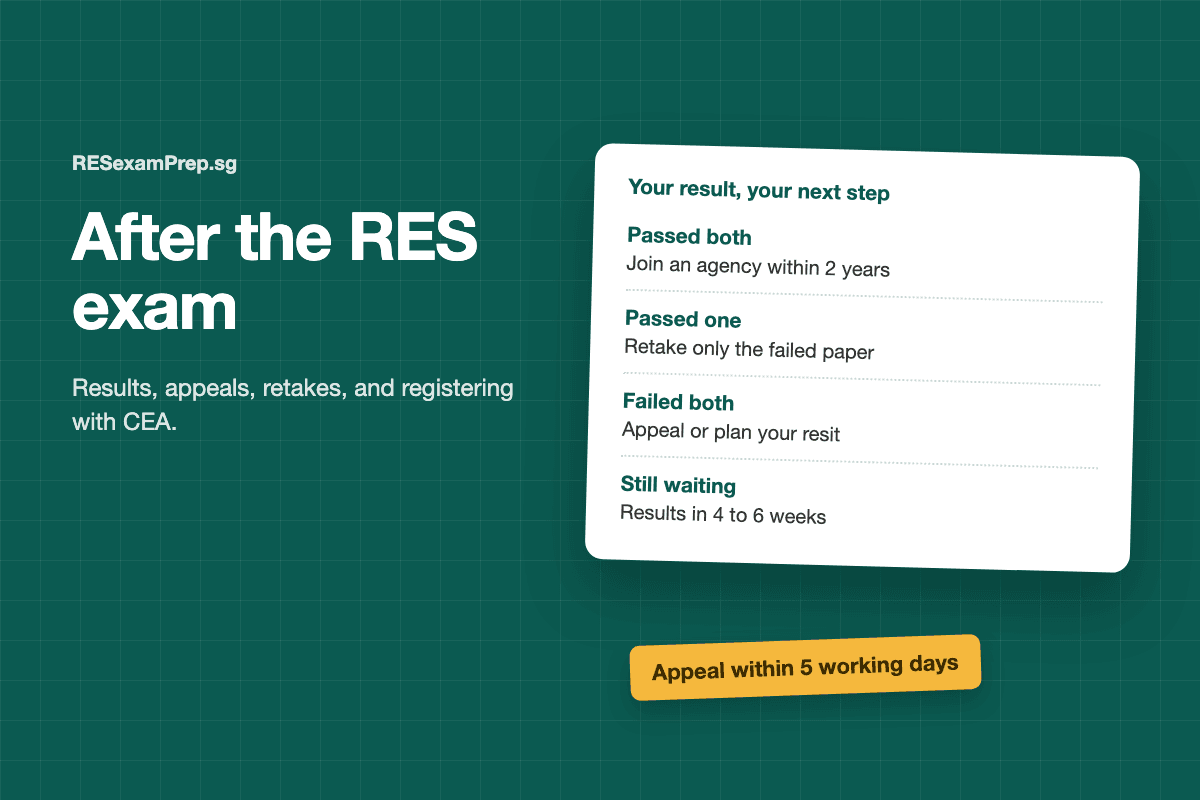
NTUC LearningHub emails your Statement of Results 4 to 6 weeks later. It shows Pass or Fail for each paper, not your marks. If you fail a paper, you can appeal within five working days of the results, or retake just that paper at a later sitting. Our registration guide covers results, appeals and registering with CEA after you pass.
Frequently Asked Questions
What time should I arrive for the RES exam?
Both papers run from 9.30am to 12pm. NTUC LearningHub asks candidates to arrive an hour before the start, so aim to be at SIM HQ by 8.30am.
What happens if I'm late for the RES exam?
If you arrive within 15 minutes of the start, you are let in at 9.45am and get no extra time. If you arrive 15 minutes or more after the start, you can't sit that paper and the fee isn't refunded. A missed paper is marked Absent and counts as a fail.
What calculator can I use in the RES exam?
Any calculator with no wireless, text-editing, programming or printing functions. It can't have a cover, instruction leaflet, or formulae printed on the lid. Phone calculator apps are not allowed because your phone must be switched off and in your bag.
Can I bring my phone into the RES exam room?
You can bring it to the venue, but it must be powered off completely (not silent, sleep or standby), with alarms turned off, and kept in your bag at the designated area of the room. If it rings or an alarm goes off, your bag is moved outside and the incident is reported to CEA.
Can I bring water or food into the RES exam?
Plain water only. Keep the bottle on the floor next to your seat. No other food or drinks are allowed in the exam room.
Can I leave the RES exam early?
Only between the first hour and the last 15 minutes, so from 10.30am to 11.45am. Once you hand in your answer sheet and leave, you can't go back in.
Are marks deducted for wrong answers in the RES exam?
Neither CEA nor NTUC LearningHub publishes any penalty for wrong answers. A blank answer always scores zero, so answer every question, even if you have to guess.
Can I go to the washroom during the RES exam?
Yes, but raise your hand and wait for an invigilator's permission. The clock keeps running and you get no extra time.
Sources
All checked on 9 November 2026. The exam rules can change, so read NTUC LearningHub's latest rules document before your sitting.
- NTUC LearningHub: RES exam rules and regulations (Oct 2026)
- NTUC LearningHub: RES exam (venue, schedule, results)
- CEA: Prepare for the real estate salesperson examination
- CEA: RES examination results and appeals
- MND written answer on the RES exam passing mark (4 Jan 2021)
- SIM: Campus locations and directions
Rehearse Exam Day Before It Counts
Practise your pacing with exam-style questions and timed mock exams for both RES papers.